
European Economic
and Social Committee
Active role for organised civil society key for a resilient EU
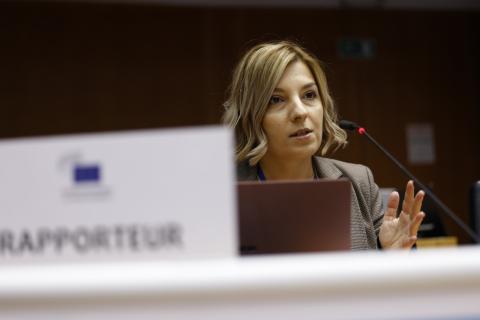
The EESC held a debate in plenary on the growing importance of organised civil society and cities in Europe's ability to face asymmetric shocks and unforeseen crises. This was linked to the adoption of two opinions, on Flexible Assistance to Territories (FAST-CARE) and on the Ljubljana Agreement on the Urban Agenda of the EU. The Committee welcomes both initiatives, but finds they miss the bar in terms of properly empowering and involving organised civil society. A key measure proposed by the EESC is to create a separate EU fund for the reconstruction and development of Ukraine to complement the efforts made by the Member States.
EESC President Christa Schweng insisted that, in the current challenging context, the right policies need to be put in place quickly. We need a framework of empowerment and involvement
, she told the assembly. Urban policy, and particularly the Urban Agenda for the EU, focuses strongly on partnership with organised civil society and multi-stakeholder approaches in sustainable urban development. It can play a vital role in the resilience and recovery of the EU economy
.
Radim Sršeň, representing the Czech Presidency of the Council of the EU, explained how important the role of the EESC is to them. We believe in a place-based, and bottom-up approach to these themes, and the EESC opinions will be used to influence current and future European policy
.
Empowering
FAST-CARE (Flexible Assistance to Territories) is the Commission's answer to the migratory challenges caused by Russia's aggression, as well as the delayed implementation of projects due to the combined effects of COVID-19, the high energy costs and the shortage of raw materials and labour. The EESC considers that the new policy package, while providing an adequate and timely response, needs to be even more flexible and more inclusive towards organised civil society. FAST-CARE for example provides that a minimum of 30% of the funding should be set aside for local authorities, social partners and civil society organisations.
This is a good idea, but 30% might be too low for countries bordering Ukraine
, explained rapporteur Elena Calistru during the debate. She highlighted: The social partners have delivered an immediate response during the first stages of the war. They also play a crucial role in the implementation and monitoring of European programmes. More should be done to help them as the needs of refugees become more medium-term and the cold season approaches
.
One of the key measures proposed in the Committee's opinion to expand the scope of FAST-CARE, is a separate EU fund to be created for the reconstruction and development of Ukraine to complement the efforts made by the Member States. The EESC called on the Council and Parliament to approve the Regulation swiftly so that it can be adopted as soon as possible.
Involving
The second opinion debated was requested by the Czech Presidency of the Council of the EU. It covers the Thematic partnerships under the Ljubljana Agreement, which is the new phase of the urban agenda for the EU (UAEU), adopted in November 2021.
Urban policy, and particularly the Urban Agenda for the EU, can play a vital role in the resilience and recovery of the EU economy
, commented rapporteur David Sventek. We support the new approach and its strong focus on partnership and multilevel and multi-stakeholder approaches. But the link with the EU Cohesion Policy could be strengthened
.
In its opinion, the EESC asks to be part of the Urban Development Group and the Urban Agenda Technical Preparatory Group in the Ljubljana Agreement. The Committee also suggests participatory democracy, the economy of wellbeing in cities, and urban-rural connections as additional themes to be approached by the thematic partnerships.
Co-rapporteur Florian Marin drew attention to a few additional points: More legitimacy and more attention on youth are needed for thematic partnerships in the future. Also, the criteria for selecting thematic partners should be open and inclusive. Working conditions, equal opportunities and adequate wages should be approached in a transversal way in the thematic partnerships
.
Work organisation
Downloads
-
Active role for organised civil society key for a resilient EU
Recommended for you
Toghadh Séamus Boland ina Uachtarán ar Choiste Eacnamaíoch agus Sóisialta na hEorpa, agus gheall sé go gcuirfear an tsochaí shibhialta i gcroílár na hEorpa
News
Toghadh Séamus Boland na hÉireann ar an 35ú Uachtarán ar Choiste Eacnamaíoch agus Sóisialta na hEorpa (CESE) le haghaidh an téarma oifige 2025-2028. Is urlabhra riamh anall é do phobail na tuaithe…
CESE, Uachtarántacht na hÉireann agus an fhís choiteann atá acu
News
I ndiaidh na díospóireachta a reáchtáladh le Comhaltaí CESE le linn sheisiún iomlánach mhí Iúil, níl aon dabht faoi ach go bhfuil clár Uachtaránacht reatha an Aontais ag freagairt go mór do na…
#YEYS2022: Ceist na bréagaisnéise pléite ag aos óg na hEorpa agus a dtuairimí ina leith curtha in iúl acu don Leas-Uachtarán Jourová
News
Chuir daltaí meánscoile ó gach cearn den Eoraip ocht gcinn de thograí nithiúla faoi bhráid Leas-Uachtarán an Choimisiúin Eorpaigh um Luachanna agus um Thrédhearcacht, Věra Jourová. Bhí páirt á…
#CivilsocietyforUkraine
News
Cáineann CESE ionradh Rialtas na Rúise ar an Úcráin, ionradh atá gan údar agus gan chúis Rún ó Choiste Eacnamaíoch agus Sóisialta na hEorpa (CESE) maidir leis an gcogadh san Úcráin agus an tionchar…
Eagrán speisialta de CESE info
News
Eagrán speisialta de CESE info atá dírithe ar an Úcráin. Is féidir scéal Tetyana Ogarkova a léamh, bean a chuala fuaim ionradh na Rúise ar dhúiseacht di an 24 Feabhra.