
European Economic
and Social Committee
The EU needs an action plan to deliver affordable and decent housing
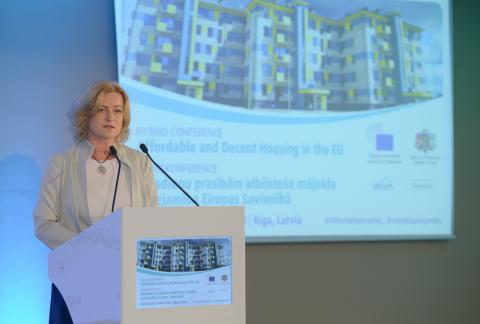
The high-level conference held in Riga by the European Economic and Social Committee (EESC) sounded the alarm on the affordable housing crisis and warned that it was high time for the EU to take action to enable Europeans to meet this basic need, now at even greater risk due to the spike in energy prices and the war in Ukraine.
The affordable housing crisis in the EU Member States has never been worse. It is time for action rather than more talk, and so the EU needs a specific action plan for housing. The conclusions of the high-level conference jointly organised by the EESC and the Latvian Ministry of Economics on 6 July 2022 in Riga are unequivocal: action is needed.
Given the current geopolitical situation, providing sustainable and affordable housing today and in the future is our top priority,
said EESC president Christa Schweng. Nowadays, stepping up the energy performance of buildings is also essential. Although housing is still a matter for the Member States, given the many challenges we must work together to find workable solutions that help people and businesses in need.
Ilze Indriksone, Latvian Minister of Economics, pointed out that the war in Ukraine had changed the way we look at housing in many ways: "This issue must be discussed right now: homes and security are important and we currently have a housing shortage. Affordable housing is a challenge but also an opportunity for everybody: municipalities, businesses and the population at large. We need to look for new solutions."
The affordable housing crisis is getting worse
The current energy supply crisis amplified by the war in Ukraine, together with the unprecedented increase in energy prices and the economic and social consequences of the COVID-19 pandemic, have exacerbated the problem of affordable housing in the EU.
Access to good quality and affordable housing is a basic need for the European population, and although housing policy remains a national competence, the shortage of decent and affordable housing in the EU requires a specific European action plan, focusing on boosting the energy performance of buildings.
At the Ministerial Conference on Housing and Construction held in Nice in March 2022, the EU Member States adopted a declaration in which they undertook to produce and invest in sustainable, affordable, decent and resilient housing that respects quality of life. The objective is to break down long-standing barriers to energy- and resource-efficient renovation and improve reuse and recycling, at least doubling renovation rates by 2030.
The EESC has been instrumental in facilitating dialogue between civil society organisations and national and European authorities. The Committee has long been involved in the European debate on sustainable and affordable housing and energy efficiency. We have worked hard to make the debate move forward, find solutions and build bridges with the public,
said Baiba Miltoviča, president of the EESC's Section for Transport, Energy, Infrastructure and the Information Society.
Towards sustainable and affordable housing
Looking ahead, building sustainable and affordable housing means first of all identifying households in need, getting access to funding, raising awareness about energy efficiency and costs, and increasing cooperation among all actors involved.
More measures are essential and this was underlined by all local, national and European participants, in particular from civil society organisations and EU institutions such as the European Parliament, the European Commission, the European Investment Bank and the European Committee of the Regions.
Sorcha Edwards and Alice Pittini from Housing Europe warned that housing was a general challenge, not an individual problem, particularly for the more vulnerable segments of society such as low-income households, young people, the elderly and migrants. The housing situation for persons with disabilities is often dire and for this reason Gunta Anča, representing the European Disability Forum, stressed the need to focus on accessibility when designing buildings.
How can we finance affordable housing? It is important to identify the best funding practices, so that we can move from traditional grants and subsidies to sustainable financing models. On this issue, Reinis Bērziņš explained how Latvian state-owned development finance institution Altum offered state aid for various target groups to compensate for market shortcomings.
Increasing building energy efficiency through renovation remains key. One successful example is the Latvian town of Valmiera. Jānis Baiks, from the Municipal Council, explained that the buildings included in the local social housing project saved significant amounts of energy thanks to improved insulation and new technologies.
At the moment, only 1% of buildings in the EU undergoes energy efficient renovation every year. In the words of Zane Petre, Head of the European Commission Representation in Latvia: Housing affordability is closely linked to sustainability and energy poverty. Creating affordable housing means synchronising environmental and social policies and also drives the economy in the region.
Work organisation
Downloads
-
The EU needs an action plan to deliver affordable and decent housing
Recommended for you
Toghadh Séamus Boland ina Uachtarán ar Choiste Eacnamaíoch agus Sóisialta na hEorpa, agus gheall sé go gcuirfear an tsochaí shibhialta i gcroílár na hEorpa
News
Toghadh Séamus Boland na hÉireann ar an 35ú Uachtarán ar Choiste Eacnamaíoch agus Sóisialta na hEorpa (CESE) le haghaidh an téarma oifige 2025-2028. Is urlabhra riamh anall é do phobail na tuaithe…
CESE, Uachtarántacht na hÉireann agus an fhís choiteann atá acu
News
I ndiaidh na díospóireachta a reáchtáladh le Comhaltaí CESE le linn sheisiún iomlánach mhí Iúil, níl aon dabht faoi ach go bhfuil clár Uachtaránacht reatha an Aontais ag freagairt go mór do na…
#YEYS2022: Ceist na bréagaisnéise pléite ag aos óg na hEorpa agus a dtuairimí ina leith curtha in iúl acu don Leas-Uachtarán Jourová
News
Chuir daltaí meánscoile ó gach cearn den Eoraip ocht gcinn de thograí nithiúla faoi bhráid Leas-Uachtarán an Choimisiúin Eorpaigh um Luachanna agus um Thrédhearcacht, Věra Jourová. Bhí páirt á…
#CivilsocietyforUkraine
News
Cáineann CESE ionradh Rialtas na Rúise ar an Úcráin, ionradh atá gan údar agus gan chúis Rún ó Choiste Eacnamaíoch agus Sóisialta na hEorpa (CESE) maidir leis an gcogadh san Úcráin agus an tionchar…
Eagrán speisialta de CESE info
News
Eagrán speisialta de CESE info atá dírithe ar an Úcráin. Is féidir scéal Tetyana Ogarkova a léamh, bean a chuala fuaim ionradh na Rúise ar dhúiseacht di an 24 Feabhra.