
European Economic
and Social Committee
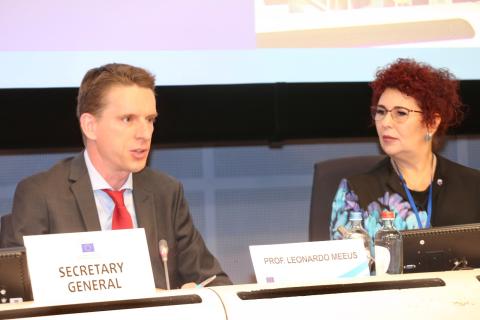
The EESC is committed and determined when it comes to decarbonising the EU's energy system and calls on EU policy-makers to tackle the consequences of decades-long energy dependence.
With these words EESC president Christa Schweng opened a debate on the EU's energy transition and strategic autonomy at the plenary session on 26 October 2022. The EESC was hosting professor Leonardo Meeus from the European University Institute in Florence.
"We need to work on a green transition at a pace that businesses and societies are able to keep up with and with accompanying measures that allow for Europe's global competitiveness and innovation," said Ms Schweng. "The EU has the potential to reduce its dependence on imported energy by developing its local renewable energy capacity, but proper investment incentives must be ensured."
Professor Meeus referred to the EU electricity market reforms proposed by the European Commission, arguing that the electricity market we have built over the past 20 years can be part of our future, as long as we complement and combine it with new instruments to engage consumers and modernise networks.
The debate was linked to the adoption of the EESC opinion A strategic vision on energy transition to enable the EU's strategic autonomy, drafted by Thomas Kattnig, Lutz Ribbe and Tomasz Andrzej Wróblewski.
The opinion sets out the EESC's vision on the energy transition and its role in achieving the EU's strategic autonomy, focusing on speeding up decarbonisation, reducing dependence on energy imports, increasing buy-in from communities and businesses and supporting vulnerable households. (mp)