This debate will bring representatives from public actors and civil society to discuss on their views on the Commission proposal to further integrate capital markets and how to make it fit for purpose.
The opinion is being elaborated as an exploratory opinion at the request of the Cypriot Presidency of the Council of the EU.
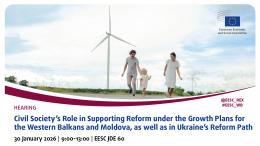
The hearing will examine how organised civil society contributes to implementing reforms within the framework of EU’s Reform and Growth Facility for the Western Balkans and the Ukraine Facility.
First session will feature insights from Brussels based stakeholders, offering perspectives from EU-level actors engaged in the region. The following session will be a discussion with stakeholders from the countries concerned that will provide on the ground viewpoints from civil society representatives and practitioners directly involved in reform processes.
Room JDE63, JDE building, Rue Belliard 99-101, 1040
Brussels
Belgium
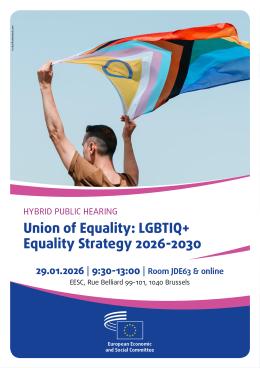
The EESC will hold a public hearing to examine the recently adopted LGBTIQ+ Equality Strategy 2026–2030. The event will bring diverse stakeholders to discuss opportunities and challenges in implementing the strategy’s actions, enforcement of anti-discrimination norms, and strategies to ensure that EU policy frameworks meaningfully foster the Union of Equality. Key questions will focus on mainstreaming LGBTIQ+ equality, monitoring and evaluation frameworks, mechanisms for Member State engagement, and strategies for bridging gaps between EU-level and national practices.
Second meeting of the EU - New Zealand Domestic Advisory Group
Location
Brussels
Belgium
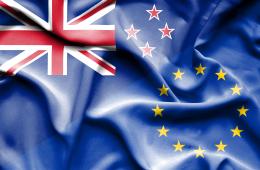
The 2nd EU-New Zealand DAG meeting took place on 28 January in Brussels, focusing on the state-of-play of implementation, including strategic exchanges with New Zealand counterparts and the European Commission. The New Zealand Ambassador to the EU confirmed the strong political commitment to open and rules-based trade, and highlighted the positive trade effects observed since the entry into force of the FTA. DG Trade confirmed that the FTA is proceeding well and confirmed that the first Civil Society Forum meeting should take place in Brussels back-to-back with the TSD Committee later this year. Overall, there is positive momentum of the EU-New Zealand FTA, the central role of civil society in its implementation, and the need for focused, pragmatic and cooperative engagement in the year ahead.
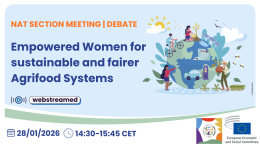
As part of its ongoing work on generational renewal in agriculture, the European Economic and Social Committee’s Section for Agriculture, Rural Development and the Environment (NAT) will hold a dedicated debate on youth in agrifood systems during its meeting on 28 January 2026 from 16:00 to 17:15.
The hearing contributes to our opinion on the European Commission’s 2025 Strategic Foresight Report (SFR) on Resilience 2.0 (Rapporteur: Philip VON BROCKDORFF) and provides input towards the 2026 SFR, which will focus on the future of the European Union in a changing world. With this hearing, we aimed to build common understanding around a new basis for multilateral cooperation for the EU and how foresight can contribute to increase resilience and preparedness.
The EU and the Viet Nam Domestic Advisory Groups (DAGs), established under the Trade and Sustainable Development (TSD) chapter of the EU-Viet Nam Free Trade Agreement, met in a "DAG-to-DAG meeting" on 20 January 2026. The event started with a workshop on EU Deforestation Regulation (EUDR), discussing consequences for SMEs and farmers and how to navigate in this area.