With this opinion the EESC wants to highlight all forms of older peoples' participation in society. It recommends eliminating any barriers to their involvement and fostering their contribution. This means: increasing the offer of adapted learning for older people, namely on ICT, encouraging them to work until the retirement age and possibly beyond, provided that work environments and contractual arrangements meet their needs, valuing their role as volunteers, in particular as informal care givers, and recognising them as important consumers of goods and services.
Download — EESC opinion: Participation of older people in society
The general objective of the new edition of the ‘Europe for Citizens’ programme will be to "strengthen remembrance and enhance capacity for civic participation at the Union level". The opinion, while strongly agreeing with this objective, sets out recommendations and specific changes that will allow the programme to be improved by bringing it still closer to citizens and better meeting their needs.
Download — EESC opinion: Europe for Citizens Programme (2014-2020)
The main aim of this European Year must be active, participatory citizenship. The Year should encourage informed, active and inclusive citizen participation in the European integration process and in political and social life. The EESC advocates specifying the legal basis for the European Year and naming it the European Year of active and participatory citizenship.
Download — EESC opinion: European Year of Citizens (2013)
The Commission's communication sets out a strategy for the implementation of the charter in the new legal environment created by the Lisbon Treaty. The charter must serve as a compass for the Union's policies and their implementation by the Member States. The EESC finds that the Commission should strengthen the culture of fundamental rights at all government levels and across all policy and legislative domains level. It is as well urgent to establish a strategy for monitoring and for rapid reaction.
Download — EESC opinion: Strategy for the effective implementation of the Charter of Fundamental Rights by the European Union
Following the third edition of Civil Society Week, the EU’s largest annual gathering of civil society representatives, the EESC reviewed its key outcomes in a plenary debate with EU institutions and stakeholders. With democratic values under growing pressure globally and across parts of the EU, civic participation is more important than ever.
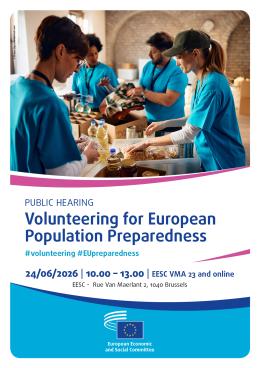
Volunteering plays a central role in building resilient and inclusive societies that are better prepared for existing and future challenges. This public hearing will gather institutional actors, civil society organisations, social partners, and experts to reflect on the role that volunteering can play in the “whole-of-society” approach to preparedness (called for by the European Commission). Discussions will feed into the related EESC Opinion (SOC/864).
The strategic role of civil society in defending EU founding values
Location
EESC, Rue Van Maerlant 2, 1000
Brussels and online
Belgium
The sixth EESC FRRL Group's annual conference will provide a platform for debate of the annual EC rule of law report, as well as of the recent country visits carried out by the FRRL Group.
EESC Members, civil society representatives (including social partners), EU institutions and other stakeholders will discuss the main recent developments in the EU in the area of fundamental rights and the rule of law, as well as the EU response notably through the rule of law review mechanism.