
European Economic
and Social Committee
EESC’s Civil Society Week 2026 has set the course for stronger democracy and civic engagement in the EU
Following the third edition of Civil Society Week, the EU’s largest annual gathering of civil society representatives, the EESC reviewed its key outcomes in a plenary debate with EU institutions and stakeholders. With democratic values under growing pressure globally and across parts of the EU, civic participation is more important than ever.
Civil Society Week, held in early March under the theme ‘People, Democracy, Resilience – Our Future’, brought together some 1000 participants over four days. The week featured more than 90 speakers and 19 sessions organised with EU institutions and national economic and social councils.
Opening the plenary debate on 18 March, EESC President Séamus Boland stressed the importance of dialogue and shared values: ‘we have shown once again why dialogue and European values matter. We can’t succeed as a Union if we don't continue upholding our values of peace, inclusion and resilience to name a few that we need so badly in these challenging times'.
Irena Moozová, Deputy Director General of the European Commission’s Directorate-General for Justice and Consumers (DG JUST), said that the Commission had taken note of the outcomes, flagging up the importance of education, citizen engagement and stronger media and digital literacy as key prerequisites for building a resilient society.
She continued by saying that this also resonates very well with some of the key objectives of the European Democracy Shield, a core component of the first ever EU civil society strategy that had been presented by the Commission in November 2025, which aims to boost societal resilience and citizen engagement.
Nicolae Ștefănuță, Vice-President of the European Parliament, commended the EESC for putting affordable housing high on the European agenda. He also stressed the need to provide more funding to civil society organisations.
‘Funding is the number one problem for civil society. Autocratic governments around the world still see civil society as a tool, not as an equal partner in democracy. It is frustrating, and we need to strengthen the budget — to reinforce where others have cut’, he said.
EESC AS A CENTRAL PARTNER IN THE CIVIL SOCIETY PLATFORM
One of the main outcomes of this year’s Civil Society Week was the first meeting of the Civil Society Platform’s steering group, marking a significant step towards more structured cooperation between EU institutions and organised civil society.
The platform, a key milestone of the civil society strategy, will be established at the end of 2026. The EESC will contribute to its development as a member of the steering group.
‘Protecting and empowering civil society is a shared responsibility, and we look forward to once again working in close cooperation to achieve this goal – and not only in the platform, but also throughout the implementation of the entire strategy’, Ms Moozova said.
‘The EESC will continue to act as a central partner in this process, alongside the European Commission, the Fundamental Rights Agency and Civil Society Europe’, confirmed Mr Boland.
Pietro Barbieri, Vice-President of the EESC Civil Society Organisations’ Group, stated that ‘the EESC is part of the civil society platform’s steering group’, and that ‘there are good signs for the platform’s launch’. He continued by saying that we must pay close attention to every detail of its design, and that important decisions are pending.
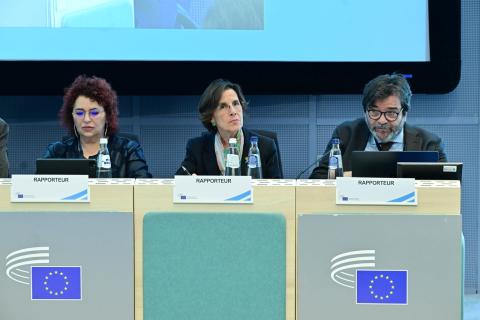
He referred to the EESC opinion on the EU Strategy for Civil Society, for which he served as rapporteur alongside Christa Schweng (Employers’ Group) and Cinzia del Rio (Workers’ Group).
‘At a time of shrinking civic space and growing pressure on activists, this EU strategy is not just welcome, it is essential and will complement the work of the EESC. We must turn it into a powerful, unified tool that strengthens civil society and safeguards our democratic values’, Ms del Rio said.
‘We will advocate a platform that is truly result-oriented, focusing on democracy, fundamental rights and the rule of law. It must be complementary, avoiding duplication and instead creating real added value. And I cannot stress this enough: with limited resources, we need to make the most of what we have’, Ms Schweng added.
The speakers said that platform must be open and accessible to all civil society organisations, that it should foster real cooperation among stakeholders – from EU institutions to Member States and CSOs – and be inclusive, ensuring that even marginalised and underrepresented voices are heard.
Civil Society Week 2026 also highlighted the growing role of participatory democracy tools, in particular the European Citizens’ Initiative (ECI), which enables citizens to contribute directly to EU policymaking.
Over four days, the event served as a platform for dialogue, cooperation and exchange on issues directly affecting citizens’ daily lives. The discussions contributed to the conclusions entitled ‘Next steps for a democratic and resilient future – delivering together a Union of opportunities, security and resilience’, which were presented at the EESC March plenary session.
These conclusions call for stronger citizenship education, social cohesion, access to affordable housing, and a supportive environment for civil society. They also highlight the need to reinforce media and digital resilience, expand participatory tools and ensure adequate funding for civil society, volunteering and the social economy.
The outcomes will feed into future EESC opinions and be transmitted to EU institutions, contributing to ongoing efforts to build a more democratic, inclusive and resilient European Union.