European Economic
and Social Committee
European Economic
and Social Committee
The European Economic and Social Committee (EESC) is the voice of organised civil society in Europe.
Find out more about its role and structure at http://www.eesc.europa.eu/en/about
The EESC issues between 160 and 190 opinions, evaluation and information reports a year.
It also organises several annual initiatives and events with a focus on civil society and citizens’ participation such as the Civil Society Prize, the Civil Society Days, the Your Europe, Your Say youth plenary and the ECI Day.
Find the latest EESC opinions and publications at http://www.eesc.europa.eu/en/our-work/opinions-information-reports/opinions and http://www.eesc.europa.eu/en/our-work/publications-other-work/publications respectively.
The EESC is active in a wide range of areas, from social affairs to economy, energy and sustainability.
Learn more about our policy areas and policy highlights at http://www.eesc.europa.eu/en/policies
The EESC holds nine plenary sessions per year. It also organises many conferences, public hearings and high-level debates related to its work.
Find out more about our upcoming events at http://www.eesc.europa.eu/en/agenda/our-events/upcoming-events
Here you can find news and information about the EESC'swork, including its social media accounts, the EESC Info newsletter, photo galleries and videos.
Read the latest EESC news http://www.eesc.europa.eu/en/news-media/news and press releases http://www.eesc.europa.eu/en/news-media/press-releases
The EESC brings together representatives from all areas of organised civil society, who give their independent advice on EU policies and legislation. The EESC's326 Members are organised into three groups: Employers, Workers and Various Interests.
Find out more about our Members and groups at http://www.eesc.europa.eu/en/members-groups
The EESC has six sections, specialising in concrete topics of relevance to the citizens of the European Union, ranging from social to economic affairs, energy, environment, external relations or the internal market.
Find out more at http://www.eesc.europa.eu/en/sections-other-bodies
By the EESC Workers' Group
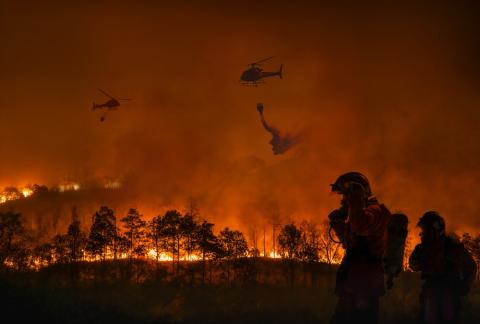
This summer, the debate on 'preparedness' and 'readiness' has once again been brought down to earth by the harsh reality of wildfires. Beyond the obscure jargon of the EU, hard truths about our societies remain and they concern real, pressing issues.
As of 27 August 2025, more than one million hectares have burned across the EU, almost five times as much as in 2024. Extensive droughts, extreme heat and severe weather conditions have made the already deadly toll of every summer even worse, particularly in Southern Europe, including the deaths of workers and volunteers on the frontlines fighting the fires.
Climate change has already shown its effects, and its impacts are becoming self-reinforcing. The 38.68 Mt of CO₂ emitted from the fires so far is equivalent to more than eight million cars' worth of emissions in one year. This shows once again that climate change policies are not optional – the consequences are already here.
The issue, nevertheless, goes beyond climate change: years of austerity and budget cuts, short-sightedness and political bickering have left EU countries ill-prepared to deal with even normal wildfire conditions (let alone the extraordinary challenges that are alarmingly quickly becoming the norm). While the solidarity shown at EU level through resource sharing is very positive, the level of political fragmentation within Member States, the lack of resources and manpower, and constant political infighting have seriously weakened the capacity of emergency services to operate.
As climate change worsens and budget debates intensify – particularly around defence expenditure – it is more important than ever to recognise the need for adequate staffing levels and resources for firefighters and all emergency workers. Over and over, they prove vital in times of crisis (as we saw during the pandemic), yet too often they receive only lip service and are forgotten once the crisis passes.