Hearing with Civil Society from Bosnia and Herzegovina
Location
Skenderija 3a
Sarajevo
Bosnia & Herzegovina
This years' meeting of the EESC's Western Balkans Follow-up Committee outside of Brussels took place on 24 May 2022 in the Delegation of the European Union in Sarajevo, Bosnia and Herzegovina, and included a hearing with the civil society organisations (CSOs).
In view of the upcoming Stockholm+50 conference and with the European Green Deal in mind, this event will explore ways of accelerating action for a better future on a healthy planet.
Interactio and Room JDE 60, EESC building, Rue Belliard 99, 1040
Brussels
Belgium
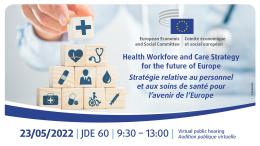
In order to prepare its own initiative opinion on "Health Workforce and Care Strategy for the future of Europe" , the EESC is organising a remote public hearing on 23 May 2022 from 9:30 am to 1 pm.
The aim of the event is to gather input from policy makers, civil society organisations and social partners, which will feed into the EESC's opinion.
With the participation of Charles Michel, President of the European Council, and Valdis Dombrovskis, Executive Vice President of the European Commission for an Economy that Works for People.
JDE62, EESC, rue Belliard 99, 1040 Brussels and online via Interactio platform
Brussels
Belgium
The CCMI conference on robotics is designed to highlight cutting edge developments in the field of robotics and more specifically to explore two main set of questions: "Robotics and Humans" and "The position of the EU robotics sector, industrial aspects".
Lessons to be drawn from the instrumentalisation of migrants and the war in Ukraine
Location
Brussels
Belgium
The meeting of the EESC's Section for External Relations is dedicated to Migration, with a conference being organised in the context of its work on the Commission's Communication Responding to state-sponsored instrumentalisation of migrants at the EU external border (JOIN (2021) 32 final). The Communication responds to the situation that arose in 2021 on the border between Belarus and the EU, but the opinion will also consider the war in Ukraine and its consequences.
The Conference on the Future of Europe, finishing on the 9th of May, has brought together various interests and citizens from all across Europe, and produced important insights and recommendations particularly from Citizens, on the kind of Europe that they want.
The focus of this meeting is to follow up on those recommendations emerged from the Conference, having an interactive debate with various speakers and our members, as well as an open discussion on the next steps to make sure the recommendations are followed through.
The next meeting of the European Economic Area Consultative Committee's will held in Bergen (Norway) on 11 May 2022. Reports and resolutions are prepared on two subjects:
a) The social aspects of the Fit for 55 package
b) The challenges and opportunities of increased use of artificial intelligence in working life