The EESC expresses concerns over rising geopolitical risks, unstable trade dynamics, and the investment deficit in Europe, stressing the need to strengthen EU competitiveness and enhance defence capabilities. The Committee also believes that it is necessary to adopt a set of measures to strengthen investment by ensuring the implementation of all Recovery and Resilience Facility (RRF) funds, with the new targets and, if necessary, deploying unused funds for new investment programmes in European public goods, creating a European Fund for Strategic Investment, strengthening the EIB's lending capacity to expand InvestEU and exploring the possibility of using European Stability Mechanism funds.
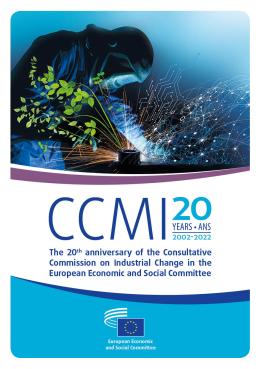
On 8 June 2022 the Consultative Commission on Industrial Change (CCMI) celebrated its 20th anniversary with a conference focused on the challenges of today and the prospects for tomorrow. This publication is a record of the occasion and a commemoration of what CCMI has achieved since joining the EESC.
Given the significance of the provision of public goods for the well-being of the citizens, the EESC believes that particular attention should be paid to providing these European public goods (EPGs) and identifying them in the next multiannual financial framework (MFF) post-2027.
Special attention must be given to ‘functional EPGs’ – those linked to Article 3 TEU – that can ensure the normal functioning of the EU: the completion of the single market; the completion of the economic and monetary union; economic, social and territorial cohesion; EU open strategic autonomy (e.g. the joint EU health policy, food security, the EU energy union); defence and security; EU research and development; and the rule of law.
The EESC assesses how the EU’s sustainable finance framework can be made more robust and fit for purpose given its importance for the EU’s economic, social and climate objectives. The EESC affirms that simplification should not come at the cost of ambition. While administrative streamlining is needed, the focus should be on how requirements can be implemented more effectively, not on weakening standards. The EU’s regulatory strength and predictability are important competitive advantages that should be preserved amid growing geopolitical and economic uncertainty.
Innovation is the real driver of growth and the key to creating employment, developing novel technologies and finding new solutions to tackle the challenges we face today and thus to increase competitiveness
On 11 February, the European Commission published its 2025 work programme. Several initiatives in the work programme – initiatives to enhance competitiveness through the promotion of reforms and investments, both private and public, the new the Savings and Investment Union, as well as the next Multiannual Financial Framework, just to name a few – fall in the remit of the Section for Economic and Monetary Union and Economic and Social Cohesion (ECO) of the European Economic and Social Committee (EESC). We organise this debate to discuss with representatives of the Commission and the members of the EESC the conditions and actions needed for the EU and its Member States to successfully implement what is outlined in the Commission and achieve the shared goals of the Union.