The European Economic and Social Committee (EESC) has called for changes to the European Union’s State aid rules in order to recognise and better accommodate the needs of social economy entities, which play a critical role in tackling societal challenges.
stresses the importance of reconciling the need for strong public support for social economy entities – which often perform functions and roles formerly performed by the State – with the EU rules on State aid, and welcomes the proposal made in the Letta report on the single market regarding the need to adapt the current legal framework on State aid in order to facilitate better access to credit and funding for social economy entities;
believes that the rules for granting aid for the recruitment of disadvantaged workers or workers with disabilities set out in Section 6 of the General Block Exemption Regulation should be strengthened and simplified. As suggested in the Letta Report, and in the communication on criteria for the analysis of the compatibility of State aid for the employment of disadvantaged and disabled workers subject to individual notification, these rules should be updated to reflect the current economic situation;
notes that the legal framework for aid for services of general economic interest (SGEIs) is not being properly harnessed by public authorities, which often fail to give sufficient attention to the high degree of discretion that is conferred on them by the Treaties with regard to the power to classify certain activities as SGEIs.
The EESC is convinced that islands, mountainous regions and sparsely populated areas face significant challenges and that there is a solid legal basis that obliges the EU to take action in order to tackle these challenges. In this context, the organised civil society has an important role to play and through this debate, the aim is to find the best practices and solutions so that these regions can perform better and recover from the multiple crises. Therefore the EESC- ECO section has decided to organise this public debate in the framework of the EESC own-intiative opinion on "Main challenges that EU islands, mountain and sparsely populated areas face.
Insularity is considered to be a permanent and unchangeable geographical feature which involves additional costs (transport, energy, waste management, public services, necessity goods and services) that hamper the development and competitiveness of the islands, while particularly exposing them to biodiversity loss and climate change. The organised civil society has an important role to play and tackle all these challenges and through this debate. The aim is to find the best practices and solutions so that EU islands can preform better and recover from the multiple crises.
How can these regions become drivers for growth and development?
Event type
Public hearing
Location
Umeå Folkets hus,
Skolgatan 59
Umeå
Sweden
The European Economic and Social Committee (EESC) will be producing an own-initiative opinion on the main challenges faced by EU islands and mountainous and sparsely populated areas, which is scheduled for adoption at the EESC's September plenary session. In this context, the EESC, along with the Conference of Peripheral Maritime Regions (CPMR) and the North Sweden European Office (NSEO), will be holding a public hearing in Umeå (Sweden) on 4 May 2023 entitled "Challenges and opportunities that the digital and energy transitions present to the northern sparsely populated areas and islands. How can these regions become drivers for growth and development?". The hearing is an event under the Swedish Presidency of the Council of the EU.
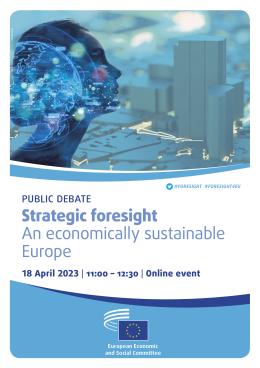
With this debate, the ECO section is providing ex-ante input to the European Commission, in preparation for the upcoming 2023 strategic foresight cycle that wants to shed light on the strategic decisions needed to ensure a socially and economically sustainable Europe with a stronger role in the world in the coming decades.
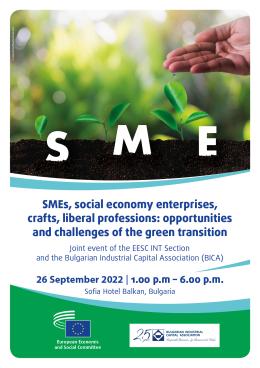
This hearing will focus on topical questions such as the possible avenues to help MSMEs be well informed and prepared to grasp the opportunities of the transition to climate neutrality, coupling it with the possibilities offered by the digitalisation and hedging the current geopolitical risks. It will also take into consideration the challenges faced by the Belgian companies and the opportunities offered to them if they successfully adjust to the climate neutral and digitalised world.
This joint high-level event focused on topical questions such as the challenges faced by Micro, Small, Medium Enterprises (MSMEs) to successfully adjust to the climate neutral and digitalised world. It has also analysed the possible avenues to help MSMEs to be well informed and prepared to grasp the opportunities of the transition to climate neutrality, coupling it with the possibilities offered by the digitalisation and hedging the current geopolitical risks.