Pajjiżi tat-tkabbir

This page is also available in:

Il-KESE jimpenja ruħu b’mod attiv fil-proċess ta’ tkabbir tal-UE u żviluppa approċċ doppju – reġjonali u bilaterali – għar-relazzjonijiet tiegħu mal-organizzazzjonijiet tas-soċjetà ċivili (OSĊ) fil-pajjiżi tat-tkabbir.

Fejn jidħol l-approċċ reġjonali, il-Kumitat ta’ Segwitu tal-Balkani tal-Punent – korp intern permanenti tal-KESE – huwa l-istrument ewlieni għall-koordinazzjoni tal-attivitajiet tal-KESE f’dan ir-reġjun. Il-Forum tas-Soċjetà Ċivili tal-Balkani tal-Punent, organizzat kull sentejn, jifforma parti mill-ħidma tal-Kumitat ta’ Segwitu.

Il-KESE jaħdem ukoll b’mod bilaterali mal-pajjiżi tal-Balkani tal-Punent u t-Turkija. Abbażi ta’ ftehimiet ta’ assoċjazzjoni bejn dawn il-pajjiżi u l-UE, bil-għan li jiġu involuti l-OSĊ fil-proċessi ta’ qabel l-adeżjoni u ta’ adeżjoni, il-KESE ħoloq tliet korpi konġunti mar-rappreżentanti tas-soċjetà ċivili – mat-Turkija, il-Montenegro u s-Serbja. Kull korp huwa magħmul minn għadd indaqs ta’ membri mill-KESE u mill-pajjiż imsieħeb u jiltaqa’ darbtejn fis-sena.

Il-KESE jżomm kuntatti regolari u jorganizza attivitajiet konġunti mal-OSĊ tal-pajjiżi tat-tkabbir li magħhom ma jkunx għadu ġie stabbilit korp konġunt ta’ rappreżentanti tas-soċjetà ċivili.

Il-ħidma tal-korpi konġunti hija komplementata mit-tħejjija ta’ Opinjonijiet tal-KESE dwar il-proċessi ta’ qabel l-adeżjoni u ta’ adeżjoni tal-pajjiżi individwali, kif ukoll dwar suġġetti ta’ interess reġjonali.
  • With youth as one of the main policy areas of the Innovation Agenda for the Western Balkans (WBs), the participants in the hearing "Youth Policy in the Western Balkans, as part of the Innovation Agenda for the WBs", held by the EESC, reaffirmed the importance of young people for the future of the region.

  • The 51st Western Balkans Follow-up Committee meeting, held on 3 December 2021, placed conflict resolution and normalisation of relations between Kosovo* and Serbia in the spotlight. The meeting, presided by Ionuţ Sibian, hosted prominent speakers from the ranks of EU officials, Western Balkans experts, as well as civil society representatives from the local communities, all of whom agreed that EU-facilitated dialogue was the only way to move forward.

  • Members of the European Economic and Social Committee (EESC) and representatives of the Montenegrin organised civil society held on the 1st March the 14th meeting of the EU-Montenegro Joint Consultative Committee (JCC), which took place online. Members of the JCC adopted a joint declaration urging the EU to assist Montenegro to face the devastating consequences of the COVID-19 pandemic in the country.

  • Event type
    JCC Meeting

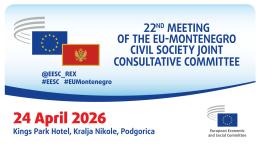
    European Economic and Social Committee (EESC) and Montenegro held its 21st Civil Society Joint Consultative Committee (JCC) on 16 December 2025, at the EESC in Brussels, Belgium. This platform, established between the EESC and Montenegrin civil society, provides a civil society perspective within the EU institutional framework related to the Stabilisation and Association Agreement between the EU and Montenegro. The JCC enables civil society organisations from both sides to monitor Montenegro's accession negotiations, discuss common interests, and inform the public about the challenges during the accession period.

    @EESC_REX   |   #EUMontenegro    |    #EESC_WB

  • Event type
    JCC Meeting

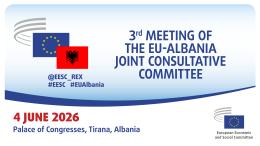
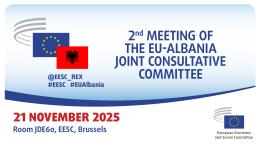
    The second meeting of the EU-Albania Joint Consultative Committee (JCC) will took place on  21 November 2025 at the EESC in Brussels, Belgium. This platform, established within the institutional framework of the EU-Albania Stabilisation and Association Agreement (SAA), will enable representatives from both the EU and Albanian civil society to monitor the country's accession negotiations, discuss issues of common interest, and highlight concerns to be addressed on Albanian's path towards the European Union.

    @EESC_REX
    #EESC
    #EESCAlbania

  • The EU-Serbia Joint Consultative Committee (JCC) held its 20th meeting on 28 November 2025 in Serbia. This platform, established within the institutional framework of the EU-Serbia Stabilisation and Association Agreement (SAA), will enable representatives from both the EU and Serbian civil society to monitor the country's accession negotiations, discuss issues of common interest, and highlight concerns to be addressed on Serbia's path towards the European Union.

    @EESC_REX
    #EESC
    #EESCSerbia

  • Building an Inclusive Future in an Enlarged EU: The role of Social Dialogue, Civil Society and Youth Engagement

    As part of its ongoing Enlargement Candidate Members (ECMs) initiative, the EESC hosted a second Enlargement Forum on 17 July 2025 in Brussels. The event gathered ministers for European affairs from candidate countries, senior officials from the European Commission, social partners, and civil society representatives to discuss the role of civil and social dialogue in the EU enlargement process.

  • The first meeting of the EU-Albania Joint Consultative Committee (JCC) took place on 4 April 2025 in Tirana, Albania. This platform, established within the institutional framework of the EU-Albania Stabilisation and Association Agreement (SAA), will enable representatives from both the EU and Albanian civil society to monitor the country's accession negotiations, discuss issues of common interest, and highlight concerns to be addressed on Albanian's path towards the European Union.

  • Event type
    JCC Meeting

    The EU-Serbia Joint Consultative Committee (JCC) held its 19th meeting on 7 April 2025 at the EESC in Brussels. This platform, established within the institutional framework of the EU-Serbia Stabilisation and Association Agreement (SAA), will enable representatives from both the EU and Serbian civil society to monitor the country's accession negotiations, discuss issues of common interest, and highlight concerns to be addressed on Serbia's path towards the European Union.


  • Civil society for an open democratic debate
    Event type
    Conference

    This conference in Lisbon is the fourth event on disinformation being hosted by the European Economic and Social Committee (EESC) as part of its ongoing project aiming to fight disinformation with the help of civil society.