
European Economic
and Social Committee
President of the French Economic, Social and Environmental Council: ‘We must never be scared to talk to people’
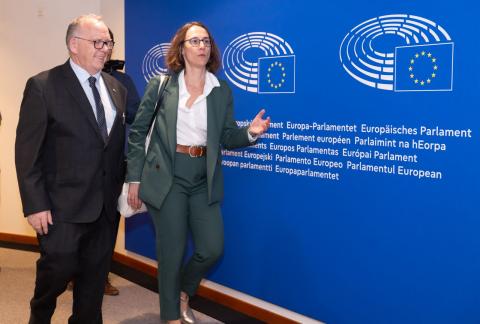
At the September plenary session, the European Economic and Social Committee (EESC) and the French Economic, Social and Environmental Council reiterated their intention to act as steadfast partners in defending the role and model of participatory democracy which are embodied in them. The end goal: helping to shape a better future for Europeans.
The newly elected President of the French Economic, Social and Environmental Council, Claire Thoury has chosen the EESC as the first European body to visit in her new role. At the September plenary debate, Ms Thoury outlined her priorities and highlighted the pressing concerns facing the EU: attacks on European values, poverty, jobs, artificial intelligence and climate change. ‘Tackling today’s major challenges calls for a strong, united Europe able to stand against the forces seeking to divide us.’
Currently, the EU needs to restore trust in democratic institutions, against a backdrop of disinformation and growing polarisation. ‘We are facing aggressive attacks on our values to which we must respond more decisively,’ said the EESC President Séamus Boland. ‘No consultative body, in Europe or elsewhere, can take its legitimacy for granted. Recurrent attacks on such institutions remind us that we must remain united, continue to demonstrate our added value, earn trust, and speak clearly and forcefully about the importance of consultative assemblies.’
Ms Thoury went on to describe the role of organised civil society as vital because ‘by testing political decisions in the real world, it promotes fairness’ and added: ‘We must not wait for our societies to be torn apart before strengthening the bonds that unite us. After all, that is what intermediary bodies do: they bridge the gap between real life and public authorities. By defending organised civil society, we are defending democracy itself. We must never be scared to talk to people and we must never give up.’
Ever-closer ties with the French Economic, Social and Environmental Council
The debate made it clear that the EESC and the French Economic, Social and Environmental Council are moving in the same direction, as their work programmes are both built around people. Cooperation is growing, particularly through thematic discussions, the promotion of opinions and participation in joint events. This demonstrates a capacity for innovation and as Ms Thoury put it: ‘I believe in civil society diplomacy’.
For instance, the ‘Erasmus of organised civil society’ exchange programme, launched in 2023, has given members and staff at the EESC and national councils the chance to forge closer ties and share views on policy and good practices. In addition, in a few weeks, the French Economic, Social and Environmental Council will launch the Citizens’ Convention on public finances.
In the current difficult geopolitical circumstances, this constructive approach to working with the French Economic, Social and Environmental Council and, more generally, with all the national economic and social councils is crucial. This is why the EESC has gradually developed a network of national economic and social councils; it already has 24 members and makes it possible to share expertise on a more frequent basis.
‘If Europe is to remain competitive while becoming more social, representative and inclusive,’ concluded Mr Boland, ‘our assemblies must continue to serve as vital platforms for dialogue between citizens, the executive and legislative authorities at both national and EU level.’
EU organised civil society calls for stronger cooperation
‘Sustained strategic cooperation between our Committee and national economic and social councils is essential for strengthening our capacity to adapt and increase our impact. Together, our institutions serve as beacons of democracy. Where an economic and social council is strong, civil society has a voice — and democracy is stronger.’
Cillian Lohan, President of the EESC’s Civil Society Organisations’ Group
‘The French Council holds a special place in our history: its model of institutionalised dialogue helped inspire that of the EESC. This experience can be of value far beyond the Union, for example in candidate and partner countries. Let’s pool our experiences to help each interested country build a model suited to its own circumstances.’
Dumitru Fornea, EESC member, EESC’s Workers’ Group
‘There is no vibrant democracy without a strong and organised civil society that is listened to. Our organisations — the French Council and the European EESC — do exactly that, albeit at different levels. Coordinating the national and European levels more effectively would strengthen the voice of organised civil society in Europe.’
Michel Chassang, EESC member, EESC’s Employers’ Group
Work organisation
Downloads
-
President of the French Economic, Social and Environmental Council: ‘We must never be scared to talk to people’
Recommended for you
EESRK: ES turi atkreipti dėmesį į socialinį tvarumą
News
Europos ekonomikos ir socialinių reikalų komitetas (EESRK) paragino Europos Komisiją paskelbti ilgai lauktą ataskaitą, kurioje būtų įvertinta galimybė išplėsti ES tvarumo taksonomijos reglamento…
Migrantų instrumentalizavimas ir Ukrainos pabėgėlių krizė verčia persvarstyti migracijos politiką
News
Dėl valstybės remiamo migrantų instrumentalizavimo, kuriuo siekiama destabilizuoti ES, ir dabartinio karo Ukrainoje, sukėlusio precedento neturintį pabėgėlių antplūdį, reikia peržiūrėti Europos…
2023 m. „Tavo Europa, tavo balsas!“ (YEYS!). Jaunimas norėtų skaidresnės, labiau skaitmenizuotos ir paprastesnės ES
News
Kovo 23–24 d. Europos ekonomikos ir socialinių reikalų komitetas (EESRK) 14-ąjį kartą pakvietė į renginį „Tavo Europa, tavo balsas!“. YEYS! renginyje Briuselyje dalyvavo 105 mokiniai, atstovaujantys…
Judumas turėtų būti pripažintas asmens teise
News
Europos ekonomikos ir socialinių reikalų komitetas (EESRK) pabrėžia, kad viešasis transportas yra būtinas norint užtikrinti galimybę naudotis pagrindinėmis paslaugomis ir jų tęstinumą. COVID-19…
EESRK jau priima paraiškas dėl pilietinės visuomenės apdovanojimo už psichikos sveikatos problemų sprendimą
News
Pilietinės visuomenės organizacijos, pavieniai asmenys ir privačios įmonės jau gali registruoti savo ne pelno projektus EESRK apdovanojimui už europiečių psichinės gerovės rėmimą gauti. Europos…