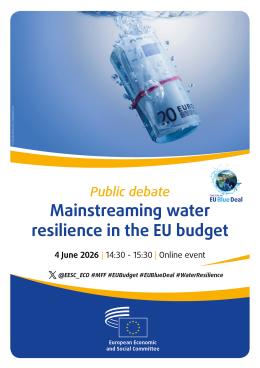
Mainstreaming Water Resilience in the EU Budget is a timely discussion on securing Europe’s water future. Discover how smarter EU investments can strengthen water resilience, sustainability, and preparedness, and how we should shape tomorrow’s funding priorities across programmes in the context of the EU´s next Multiannual Financial Framework.
The Single Digital Booking and Ticketing Regulation (SDBTR) aims to make rail travel more accessible by allowing passengers to book multi-operator journeys through a single digital platform. It focuses specifically on expanding digital access to rail tickets and fares and reduces ticketing fragmentation while ensuring passengers retain their rights throughout the entire journey.
Download — Tuairim ó CESE: Single Digital Booking and Ticketing Regulation (SDBTR)
The opinion examines the 2030 Consumer Agenda, a new five-year strategy for EU consumer policy. The Agenda addresses four key priority areas: a) an action plan for consumers in the single market; b) digital fairness and consumer protection online; c) sustainable consumption; d) effective enforcement and redress.
The EESC regrets, that the Commission has once again refrained from presenting the Annual Sustainable Growth Survey (ASGS) and stresses that sustainable economic growth is a necessary condition for Europe to meet its multiple commitments, welcomes the European Macroeconomic Report, which provides a deep dive into the underlying structural challenges facing the EU and the new recommendation on human capital, which is a crucial element in filling the EU technological gap, also taking into account the EU demographic challenge. The Committee reiterates its call for more robust commonfiscal capacity, supported by targeted issuances of joint debt, to help fill this growing gap in public investment, and for permanent macroeconomic stabilisation instruments to address shocks.
Download — Tuairim ó CESE: 2026 European Semester – Autumn Package
Cultured meat (CM) is raising interest globally, including from multinational food companies, as an innovative technology to produce meat without farming animals. This completely different way of obtaining animal proteins is perceived as disruptive to the existing system. This study reviews the state of the art of research related to the potential impact of CM development on environmental, social and economic aspects of sustainability, highlighting important knowledge gaps. These gaps fuel polarised positions.
The EESC will hold an online event on Tuesday 20 May 2025 to discuss the EU wine policy package in which the Commission proposed to amend the relevant wine regulations to introduce targeted measures to help the sector manage production potential, adapt to changing consumer preferences and exploit new market opportunities.
The EESC expresses concerns over rising geopolitical risks, unstable trade dynamics, and the investment deficit in Europe, stressing the need to strengthen EU competitiveness and enhance defence capabilities. The Committee also believes that it is necessary to adopt a set of measures to strengthen investment by ensuring the implementation of all Recovery and Resilience Facility (RRF) funds, with the new targets and, if necessary, deploying unused funds for new investment programmes in European public goods, creating a European Fund for Strategic Investment, strengthening the EIB's lending capacity to expand InvestEU and exploring the possibility of using European Stability Mechanism funds.
The EESC considers that the Commission proposal on the topic of the EU wine policy comes at a crucial time for the wine sector and the Committee will therefore carry out a detailed analysis of the proposal and draft an opinion aimed at assisting the EU institutions and all stakeholders.
A new report on Europe’s progress toward the Sustainable Development Goals (SDGs) highlights a significant slowdown, raising concerns about the EU’s ability to meet the 2030 targets. The Europe Sustainable Development Report 2025 (ESDR), published by the UN Sustainable Development Solutions Network (SDSN), finds that the pace of SDG progress between 2020 and 2023 was more than twice as slow as in the previous period.