
European Economic
and Social Committee
When uncertainty becomes the new tariff
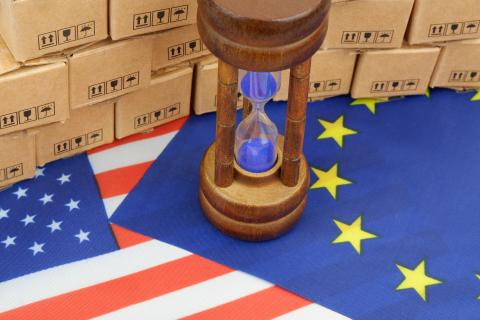
Europe’s economic relationship with the United States is often described as resilient. In reality, it is indispensable and therefore dangerously exposed to policy shocks.
The EU-US economic corridor remains the largest bilateral trade and investment relationship in the world. Europe exports more than €500bn in goods to the US every year, according to Eurostat, powering jobs across manufacturing, pharmaceuticals, technology, agri-food and services. Yet, in an era where tariff lines change overnight, confidence is crumbling.
For companies, uncertainty has de facto become the new tariff. Entire teams now spend their days refreshing so-called “tariff trackers” to keep up with the latest announcements, counter-announcements, court rulings, and threats of new duties. When businesses need real-time dashboards just to know if their goods can cross a border tomorrow, something has gone badly wrong.
Businesses thrive on predictability; its absence is corrosive.
This moment should alarm policymakers on both sides of the Atlantic. The Turnberry Deal was meant to reset trust after years of tensions, trade disputes, retaliatory tariffs, and post‑pandemic protectionism. Instead, it risks becoming another casualty of escalating tariff chaos.
The immediate collateral damage? Europe’s own industrial base.
For much of the post-Cold War period, tariffs were treated as tactical tools on a long road towards liberalisation. That assumption no longer holds. Analysts at the Peterson Institute for International Economics and other policy institutions have observed that US trade measures increasingly reflect industrial strategy, domestic employment priorities, and supply-chain security considerations rather than traditional market-access objectives.
Trade competence exists at EU level for a reason: negotiating power rests on unity, scale and credibility. Mixed political messaging or diverging national signals reinforce Washington’s perception that pressure yields concessions.
The United States of President Trump values strength above everything else. Member States cannot afford to be played against one another. A divided Europe invites negotiation fatigue and creates space for competing blocs to set the standards of global trade.
The remedy is clear and urgent: Europe must speak with one voice. This means a single, firm, collective stance towards Washington that restores legal certainty, guarantees customs predictability, and sets a credible timeline for implementation. Businesses don’t expect immunity from every geopolitical shock, but they do expect the EU to manage them with unity, clarity and foresight.
Above all, Europe must invest in its own competitiveness. In a prolonged era of trade weaponisation, only a stronger and competitive industrial base within a fully-fledged single market can preserve cooperation with reliable partners. That means accelerating new trade agreements, deepening existing partnerships, and diversifying markets to reduce exposure to transatlantic volatility. The current tariff turmoil is unlikely to be the last.
If businesses begin to treat transatlantic access as politically contingent rather than structurally reliable, the adjustment won't come as sudden crash, but as a gradual diversion of investment flows, a slow re-engineering of supply chains, and a steady erosion of Europe's preferred position within US-linked industrial ecosystems.
Such shifts, once embedded, are extremely difficult to reverse.
The EU-US economic relationship is too big to fail suddenly. But it is not too big to fade gradually. And gradual weakening - not sudden collapse - is precisely how systemic economic repositioning usually occurs.
Tariffs rarely destroy trade overnight. Uncertainty, however, can quietly redirect it for decades.
By Mira Maria Danisman, President of the EESC International Trade follow-up Committee, and Stefano Mallia, Vice-president of the EESC Transatlantic Relations Follow-up Committee.
Work organisation
Recommended for you
Toghadh Séamus Boland ina Uachtarán ar Choiste Eacnamaíoch agus Sóisialta na hEorpa, agus gheall sé go gcuirfear an tsochaí shibhialta i gcroílár na hEorpa
News
Toghadh Séamus Boland na hÉireann ar an 35ú Uachtarán ar Choiste Eacnamaíoch agus Sóisialta na hEorpa (CESE) le haghaidh an téarma oifige 2025-2028. Is urlabhra riamh anall é do phobail na tuaithe…
CESE, Uachtarántacht na hÉireann agus an fhís choiteann atá acu
News
I ndiaidh na díospóireachta a reáchtáladh le Comhaltaí CESE le linn sheisiún iomlánach mhí Iúil, níl aon dabht faoi ach go bhfuil clár Uachtaránacht reatha an Aontais ag freagairt go mór do na…
#YEYS2022: Ceist na bréagaisnéise pléite ag aos óg na hEorpa agus a dtuairimí ina leith curtha in iúl acu don Leas-Uachtarán Jourová
News
Chuir daltaí meánscoile ó gach cearn den Eoraip ocht gcinn de thograí nithiúla faoi bhráid Leas-Uachtarán an Choimisiúin Eorpaigh um Luachanna agus um Thrédhearcacht, Věra Jourová. Bhí páirt á…
#CivilsocietyforUkraine
News
Cáineann CESE ionradh Rialtas na Rúise ar an Úcráin, ionradh atá gan údar agus gan chúis Rún ó Choiste Eacnamaíoch agus Sóisialta na hEorpa (CESE) maidir leis an gcogadh san Úcráin agus an tionchar…
Eagrán speisialta de CESE info
News
Eagrán speisialta de CESE info atá dírithe ar an Úcráin. Is féidir scéal Tetyana Ogarkova a léamh, bean a chuala fuaim ionradh na Rúise ar dhúiseacht di an 24 Feabhra.