
European Economic
and Social Committee
EU budget – The next Multiannual Financial Framework should be strong and ambitious to deliver European public goods
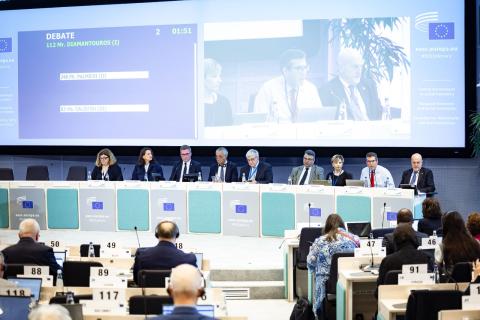
At its April plenary session, the European Economic and Social Committee (EESC) hosted a debate where EESC members underlined the strategic importance of the next Multiannual Financial Framework to address Europe’s growing challenges.
The EESC calls for a strong European budget that gives the EU the financial resources it needs to achieve its political priorities. The next Multiannual Financial Framework (MFF) must remain strong and ambitious, and must be seen as an investment to put into practice EU priorities and European public goods.
Speaking at the EESC plenary session on 30 April 2025, EESC President Oliver Röpke said: ‘In times of transition and uncertainty, Europe needs a future-proof budget that empowers us to act, protect and transform. We need an MFF that is an investment tool for European public goods. We need to mobilise investment to foster our green, blue, digital and social transitions’.
He then continued: ‘Simplification and accessibility of EU funding is crucial. The next MFF must streamline funding instruments, harmonise rules and reduce bureaucracy to deliver real results on the ground’.
More specifically, the EESC is in favour of a significant increase of the MFF in real terms in order to address the huge challenges faced by the EU. This means that the mechanism to adjust the MFF to inflation, which has traditionally capped the annual increase in contributions to the budget at 2%, should change in order to preserve the real spending power of the MFF.
The need for a new concept for the EU budget
The debate took place in conjunction with the adoption of the EESC opinion The road to the next Multiannual Financial Framework, drawn up by Elena-Alexandra Calistru, Konstantinos Diamantouros and Stefano Palmieri.
Referring to the importance of the MFF at a crucial time, when a number of unprecedented crises create tensions between the EU’s strategic objectives and its budget’s size and allocation, Elena-Alexandra Calistru said: ‘We need a different approach to EU budget governance. The next MFF must strengthen the EU’s role as a guardian of democracy through a robust ‘democracy shield’ framework supporting civil society, independent media and democratic institutions’
Focusing on EU competitiveness, Konstantinos Diamantouros added: ‘The next Multi-Annual Financial Programme must prioritise investments that can enhance the European Union’s competitiveness. Co-financing must be foreseen for Important Projects of Common European Interest to allow for companies from all countries of the European Union to participate on an equal footing and strengthen industrial value chains across the whole bloc’.
Stressing how vital social aspects are, Stefano Palmieri emphasised the fact that ‘the size and severity of the crises that the EU is facing today requires the contribution of an adequate size of its multiannual budget. It is important that the new MFF fully considers the importance of European public goods and the role they can play in the future of the EU and its social cohesion’.
Civil society representatives look to the future
During the debate, EESC member Isabel Yglesias Julià, on behalf of the EESC’s Employers’ Group, stated: ‘The next MFF must be consistent with the challenges that the EU is facing. It should go hand in hand with simplification, which is essential to make the MFF transformative for the private sector, encourage investment and serve as a lever for decarbonisation’.
Reminding the audience about the importance of investing in human capital, EESC member Dominika Biegon, representing the EESC’s Workers’ Group, highlighted that ‘We see an increase in military expenditure with relaxed rules, while fiscal space for hospitals, schools and infrastructure is severely limited. This is creating a trade-off between social and defence expenditure.’
On behalf of the EESC’s Civil Society Organisations’ Group, Luca Jahier, President of the EESC’s European Semester Group, said: ‘The next MMF is of utmost importance to clearly demonstrate if Europe wants to be at the forefront of today’s challenges, or if Europe wants to live a progressive, relentless agony. A strong and ambitious MFF is essential: it must reach 2% of EU GDP at the comprehensive level, to ensure needed investments in the core European common goods, which are competitive sustainability, green, digital and social transitions, cohesion, security and defence and international cooperation.’
Work organisation
Recommended for you
Toghadh Séamus Boland ina Uachtarán ar Choiste Eacnamaíoch agus Sóisialta na hEorpa, agus gheall sé go gcuirfear an tsochaí shibhialta i gcroílár na hEorpa
News
Toghadh Séamus Boland na hÉireann ar an 35ú Uachtarán ar Choiste Eacnamaíoch agus Sóisialta na hEorpa (CESE) le haghaidh an téarma oifige 2025-2028. Is urlabhra riamh anall é do phobail na tuaithe…
CESE, Uachtarántacht na hÉireann agus an fhís choiteann atá acu
News
I ndiaidh na díospóireachta a reáchtáladh le Comhaltaí CESE le linn sheisiún iomlánach mhí Iúil, níl aon dabht faoi ach go bhfuil clár Uachtaránacht reatha an Aontais ag freagairt go mór do na…
#YEYS2022: Ceist na bréagaisnéise pléite ag aos óg na hEorpa agus a dtuairimí ina leith curtha in iúl acu don Leas-Uachtarán Jourová
News
Chuir daltaí meánscoile ó gach cearn den Eoraip ocht gcinn de thograí nithiúla faoi bhráid Leas-Uachtarán an Choimisiúin Eorpaigh um Luachanna agus um Thrédhearcacht, Věra Jourová. Bhí páirt á…
#CivilsocietyforUkraine
News
Cáineann CESE ionradh Rialtas na Rúise ar an Úcráin, ionradh atá gan údar agus gan chúis Rún ó Choiste Eacnamaíoch agus Sóisialta na hEorpa (CESE) maidir leis an gcogadh san Úcráin agus an tionchar…
Eagrán speisialta de CESE info
News
Eagrán speisialta de CESE info atá dírithe ar an Úcráin. Is féidir scéal Tetyana Ogarkova a léamh, bean a chuala fuaim ionradh na Rúise ar dhúiseacht di an 24 Feabhra.