
European Economic
and Social Committee
A strong EU wind industry is vital for environmental, economic and social well-being
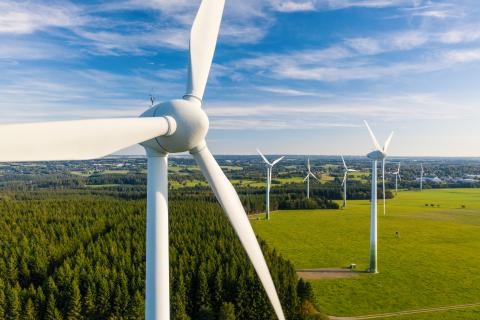
In an opinion adopted at its March plenary, the European Economic and Social Committee (EESC) underlines that wind power is a key component of the green transition, pointing out the need for expanded and modernised energy grids, socio-environmental criteria in auctions and comprehensive public participation.
A strong wind industry could improve the EU’s environmental, economic and social well-being. This is the main idea of the EESC opinion drafted by Thomas Kattnig and adopted at the March plenary session.
Faced with growing pressure from international competitors such as China, the European Union needs to step up its wind industry and promote its wind power development.
To achieve this result, the bloc must significantly expand, modernise and digitalise its grid infrastructure and, at the same time, it must create the corresponding storage infrastructure.
The European wind industry is an important pillar of the green transition. Developing grids for connecting, transmitting and distributing wind power will make it possible to integrate a substantially increased volume of wind power into the energy system,
said Mr Kattnig.
Grid auctions must stick to environmental, labour and social standards
Wind power must be seen as critical infrastructure, with all corresponding privileges and due diligence obligations, and all the approval procedures on tenders and permits must be urgently and fully digitalised and accelerated.
In addition, when organising auctions to determine how to allocate funds for renewable energy, it is essential to apply high pre-qualification criteria to make sure that all bidders comply with strict environmental, labour and social standards.
Companies should always abide by security, occupational safety, collective bargaining, social and environmental requirements such as the need to promote a circular economy.
Purely price-based auctions promote a race to the bottom that harms the environment and workers and puts companies that are eager to contribute, for example through investments in environmental and biodiversity protection, at a disadvantage.
Energy communities are a significant asset for wind power
The participation of citizens and organised civil society remains essential. The energy transition will only be a success if they are invited to become active drivers. Without their involvement, the social acceptance of the transition is at risk, and wind power will be as well.
Energy communities, energy cooperatives and energy sharing are valuable vehicles to boost the dissemination of wind power and represent an interesting form of extended prosumption from three points of view: social (participation and acceptance), economic (mobilisation of additional capital) and energy (generation closer to demand).
The European Commission should therefore recognise their important contribution in social, economic and energy efficiency terms by including effective citizen participation as the 7th pillar of the proposed Wind Power Action Plan.
Background
In October 2023, the European Commission presented a European Wind Power Action Plan to ensure that the clean energy transition goes hand-in-hand with industrial competitiveness and that wind power continues to be a European success story.
The Action Plan will help maintain a healthy and competitive wind energy supply chain, with a clear and secure pipeline of projects, attracting the necessary financing and competing on a level playing field globally. It is accompanied by a Communication on delivering on the EU’s offshore energy ambition, including wind power, following up on the EU Offshore Renewable Energy Strategy which was adopted three years ago.
The Action Plan sets out immediate actions to be taken together by the European Commission, the Member States and the industry, building on existing policies and legislation and focusing on six main areas:
- acceleration of deployment through increased predictability and faster permitting;
- improved auction design;
- access to finance;
- a fair and competitive international environment;
- large-scale skills partnerships for renewable energy;
- industry engagement and Member States’ commitments.
Work organisation
Recommended for you
Toghadh Séamus Boland ina Uachtarán ar Choiste Eacnamaíoch agus Sóisialta na hEorpa, agus gheall sé go gcuirfear an tsochaí shibhialta i gcroílár na hEorpa
News
Toghadh Séamus Boland na hÉireann ar an 35ú Uachtarán ar Choiste Eacnamaíoch agus Sóisialta na hEorpa (CESE) le haghaidh an téarma oifige 2025-2028. Is urlabhra riamh anall é do phobail na tuaithe…
CESE, Uachtarántacht na hÉireann agus an fhís choiteann atá acu
News
I ndiaidh na díospóireachta a reáchtáladh le Comhaltaí CESE le linn sheisiún iomlánach mhí Iúil, níl aon dabht faoi ach go bhfuil clár Uachtaránacht reatha an Aontais ag freagairt go mór do na…
#YEYS2022: Ceist na bréagaisnéise pléite ag aos óg na hEorpa agus a dtuairimí ina leith curtha in iúl acu don Leas-Uachtarán Jourová
News
Chuir daltaí meánscoile ó gach cearn den Eoraip ocht gcinn de thograí nithiúla faoi bhráid Leas-Uachtarán an Choimisiúin Eorpaigh um Luachanna agus um Thrédhearcacht, Věra Jourová. Bhí páirt á…
#CivilsocietyforUkraine
News
Cáineann CESE ionradh Rialtas na Rúise ar an Úcráin, ionradh atá gan údar agus gan chúis Rún ó Choiste Eacnamaíoch agus Sóisialta na hEorpa (CESE) maidir leis an gcogadh san Úcráin agus an tionchar…
Eagrán speisialta de CESE info
News
Eagrán speisialta de CESE info atá dírithe ar an Úcráin. Is féidir scéal Tetyana Ogarkova a léamh, bean a chuala fuaim ionradh na Rúise ar dhúiseacht di an 24 Feabhra.