
European Economic
and Social Committee
#EnergyPoverty – Women more likely to be affected than men
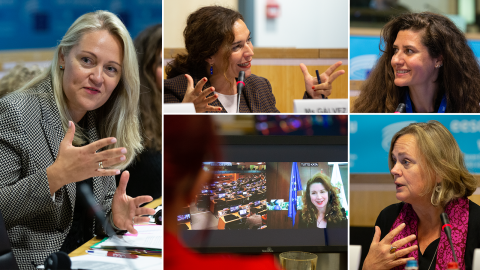
Due to economic, physiological and socio-cultural reasons, women may end up falling into energy poverty more easily than men. In light of recent alarming statistics, the thematic debate organised by the European Economic and Social Committee (EESC) urged the EU to adopt policies where gender is considered as a specific factor.
Energy poverty reflects gender inequality, affecting women more heavily than men, and the European Union can only fight this issue effectively by adopting a gender-aware approach in all its policies.
This is the main conclusion of the "Women in energy poverty" debate held by the EESC's Section for Transport, Energy, Infrastructure and Information Society (TEN) in Brussels on 9 November 2022, following the European Parliament's initiative on the European Gender Equality Week.
The statistics of women in energy poverty around the world are appalling. Today, given the start of the winter season and the rise in energy prices, the situation appears more pressing than ever,
stated Baiba Miltoviča, the TEN section's president.
Also warning about the seriousness of the issue, Maria Nikolopoulou, president of the EESC Equality Group, underlined: Energy poverty is a structural problem. It is not only related to energy prices, but also to people's income, affecting the most vulnerable people, who are mostly women.
Why women are at higher risk of being energy poor than men
Energy poverty makes the gender gap bigger and more serious worldwide; 1.3 billion people in developing countries live in poverty. Around 70% of these are women.
According to the latest research, women are more likely to fall into energy poverty as they are the main users and producers of household energy.
Katharina Habersbrunner, from Women Engage for a Common Future (WECF), explained that women and women-led households were disproportionally affected by energy poverty for a number of reasons: physiological (heat and cold sensitivity), health (mental, physical and social stress), economic (gender pay, care and pension gap, single parents) and socio-cultural issues (gender roles, care work, decision-making and representation).
Women are more likely to be responsible for housework and cooking activities requiring energy sources. MEP Lina Gálvez Muñoz, member of the Committee on Women's Rights and Gender Equality (FEMM), believes that women's tendency to assume care responsibilities and their precarious participation in the labour market are likely to bring about both income and time poverty because women generally have little time to look for information about support services.
Gender should be a key factor in EU policymaking
In the European Union, there are limited data available on the impact of energy poverty on men and women.
In 2016, the European Parliament adopted a specific resolution on access to energy, calling for gender‑sensitive energy policies and focusing on women with particular needs. Unfortunately, this call for action was largely ignored.
As a result, only a few Member States have adopted definitions and indicators, but they do not usually consider gender.
However, there are statistics confirming that women are more affected by energy poverty than men. A study carried out in Barcelona in 2016 showed that 70% of social service subsidies to combat energy poverty were granted to women.
Single mothers are a particular target. The risk of energy poverty is higher in single-parent families and 80% of them are made up of women.
Older women are also more likely to become energy poor due to a higher life expectancy and lower pensions than men.
There is no doubt that women are the first to suffer from public budget cuts at local level, for example dimmed street lights and reduced public transport, as they are the most frequent users of these services, said Kata Tüttő, Deputy Mayor of Budapest and member of the European Committee of the Regions.
Transport and mobility poverty are two other aspects of the same coin, stressed Ana Sanz Fernández from the Polytechnic University of Madrid, who outlined the feminisation of energy poverty in the city of Madrid, where almost 23% of households are at risk.
The TEN section will now put together all these contributions and turn them into concrete civil society proposals to help tackle energy poverty through a gender lens. The issue will be further discussed at the next EESC energy poverty conference, which will take place in July 2023.
Work organisation
Recommended for you
Toghadh Séamus Boland ina Uachtarán ar Choiste Eacnamaíoch agus Sóisialta na hEorpa, agus gheall sé go gcuirfear an tsochaí shibhialta i gcroílár na hEorpa
News
Toghadh Séamus Boland na hÉireann ar an 35ú Uachtarán ar Choiste Eacnamaíoch agus Sóisialta na hEorpa (CESE) le haghaidh an téarma oifige 2025-2028. Is urlabhra riamh anall é do phobail na tuaithe…
CESE, Uachtarántacht na hÉireann agus an fhís choiteann atá acu
News
I ndiaidh na díospóireachta a reáchtáladh le Comhaltaí CESE le linn sheisiún iomlánach mhí Iúil, níl aon dabht faoi ach go bhfuil clár Uachtaránacht reatha an Aontais ag freagairt go mór do na…
#YEYS2022: Ceist na bréagaisnéise pléite ag aos óg na hEorpa agus a dtuairimí ina leith curtha in iúl acu don Leas-Uachtarán Jourová
News
Chuir daltaí meánscoile ó gach cearn den Eoraip ocht gcinn de thograí nithiúla faoi bhráid Leas-Uachtarán an Choimisiúin Eorpaigh um Luachanna agus um Thrédhearcacht, Věra Jourová. Bhí páirt á…
#CivilsocietyforUkraine
News
Cáineann CESE ionradh Rialtas na Rúise ar an Úcráin, ionradh atá gan údar agus gan chúis Rún ó Choiste Eacnamaíoch agus Sóisialta na hEorpa (CESE) maidir leis an gcogadh san Úcráin agus an tionchar…
Eagrán speisialta de CESE info
News
Eagrán speisialta de CESE info atá dírithe ar an Úcráin. Is féidir scéal Tetyana Ogarkova a léamh, bean a chuala fuaim ionradh na Rúise ar dhúiseacht di an 24 Feabhra.