
European Economic
and Social Committee
COP30 ends with warnings of lost momentum as civil society demands bolder action
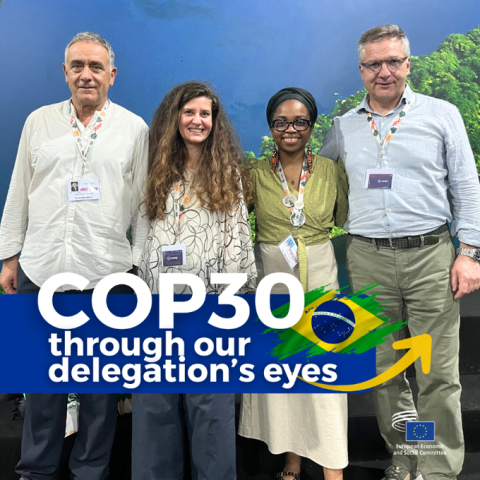
At its December plenary, the European Economic and Social Committee (EESC) held a debate on “Thirty COPs later and a decade after the Paris Agreement: assessing global climate action and opportunities for civil society”, with reactions to the outcome of COP30 at the center of discussion. The conference in Belém closed with a now-familiar warning: the world remains far from the ambition needed to keep global warming within 1.5°C.
While COP30 preserved the UN climate governance framework, negotiators once again failed to agree on a roadmap for phasing out fossil fuels — a gap that scientists and civil society argue leaves the world drifting further off course. For the EESC, which has long called for a decisive shift away from fossil energy and deeper emissions cuts, this shortfall is a serious concern.
Beyond the negotiating rooms, the EESC delegation, part of the wider European delegation and led by Stoyan Tchoukanov, president of the Agriculture, Rural Development and Environment (NAT) section, worked actively to ensure civil society’s voice remained visible. The delegation included Youth Delegate Samira Ben Ali and members Maria Nikolopoulou and Josep Puxeu Rocamora. The Committee co-organised several high-profile side events, including Ten Years After the Paris Agreement and Defending the Right to a Healthy Environment, the latter focusing on the growing role of climate litigation and the implications of the International Court of Justice’s recent advisory opinion.
EESC President Seamus Boland captured the stakes clearly, urging resilience in the face of climate fatigue: “Today we reflected on the COP’s outcomes and the broader issues shaping future climate discussions. It is easy to feel overwhelmed by the negativity that often surrounds the climate debate, but we must not allow this. I urge you and those around you to hold on to optimism, commitment, energy and hope. Without them, we risk losing a battle we cannot afford to lose.”
Youth Delegate Samira Ben Ali stressed the responsibility to act decisively: “We need to do more. It is our legal duty, not a wishful thought. We need more ambition, and we must use laws and science to guide us.”
NAT section president Stoyan Tchoukanov highlighted the gaps between civil society and politicians across the world and called for strengthening their links.
“Civil society is the driving force for accountability. It reminds negotiators that climate action must be just, inclusive and rooted in real people’s lives, pushing leaders toward stronger and more fairer action.”
Despite the frustrations, the negotiations were not without progress. Delegates advanced work on Just Transition pathways, adaptation indicators and climate-finance commitments. Informal coalitions exploring fossil-fuel phase-outs, though outside the formal UNFCCC track, are also creating limited but real momentum ahead of COP31 in Turkey.
As the EESC debate underscored, civil society expects COP31 to mark a turning point. The era of half-measures has passed: only bold, science-aligned and justice-centred policies will suffice.
Background
- Commissionner Hoekstra’s assessment
In his post-COP debriefing, EU chief negotiator Commissioner Wopke Hoekstra described COP30 as “an important step forward,” though one that did not close the emissions gap or deliver on the pledge to transition away from fossil fuels. He noted progress on adaptation funding for vulnerable nations, reaffirmation of last year’s Dubai outcomes, and the formation of a coalition to advance a fossil-fuel phase-out roadmap, while warning that the world “urgently needs faster climate action.”
- European Commission / DG CLIMA perspective
COP30 delivered limited but meaningful progress. The EU arrived with strengthened climate targets for 2035 and 2040, reinforcing its leadership role. The conference advanced adaptation efforts, agreeing to triple global adaptation finance by 2035 and adopting the first global indicators to track progress. Strong language on human rights, Indigenous peoples and the just transition aligned closely with EU priorities.
However, COP30 again failed to secure a global fossil-fuel phase-out roadmap, a key EU objective, and the final deal is widely seen as falling short of the urgency required. Still, the summit confirmed that multilateral climate cooperation remains viable. The EU will now focus on implementation and continued diplomatic work to raise global ambition ahead of COP31. (ks)