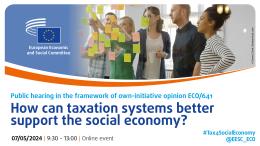
Public hearing in the framework of own-initiative opinion ECO/641 - Taxation Framework for Social Economy Entities
Event type
Public hearing
Location
Online event
Brussels
Belgium
The social economy is a vital part of the European social and economic system. It generates and maintains high-quality jobs, fosters the inclusion of marginalised groups into the labour market, promotes sustainable business practices, and provides employment for millions of people. In this way, it makes the single market more inclusive, our societies more cohesive and fosters employment models that are tailored to local and communal needs.
The EESC in the context of the European elections campaign #UseYourVote is organizing a book-talk event on EU elections 2024: where is Europe heading to? with the participation of Paolo Gentiloni Commissioner for Economy and Luca Jahier, former EESC president and author of the book "Farel'Europa, fare la pace". The debate will be moderated by Marco Zatterin, Deputy chief editor of "La Stampa".
This public hearing aims to exchange views with civil society representatives from candidate countries and EU's stakeholders on the opportunities and challenges for the EU-agri-food sector with EU enlargement and to identify the contributions of the accession countries to the EU's social, environmental, and economic sustainability.
During the meeting, DG Trade updated the EU DAG on the EU-Vietnam FTA in general and on the implementation of the TSD-chapter in particular. The EU DAG discussed main challenges for companies related to due diligence legislation and how to take the work of the DAG on this topic further, the space for civil society in Vietnam based on the presentation of a recent report on Directive 24, and the issue of cat and dog meat trade and consumption in Vietnam from a health perspective. The members also exchanged views on the DAG's priorities for this mandate.
Ana Gallego Torres, Director General, Directorate-General for Justice and Consumers (DG JUST), Ken Godfrey, Executive Director of the European Partnership for Democracy, Ylva Johansson, European Commissioner for Home Affairs; Maive Rute, Deputy Director-General, Directorate-General for Internal Market, Industry, Entrepreneurship and SMEs (DG GROW); Lanfranco Fanti, Member of the Cabinet of Commissioner for Equality Helena Dalli; Florence Raes, Director of UN Women Brussels, Mary Collins, Secretary General of the European Women's Lobby, Ilaria Todde, Advocacy Director of the Eurocentralasian Lesbian Community and Sif Holst, President of the EESC Equality Group.
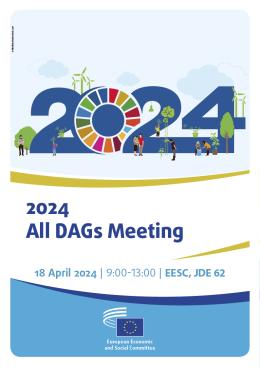
The 4th annual All DAGs meeting took place on Monday 18 April 2024 09:00-13:00 at the EESC premises in JDE62. This was the first All DAGs meeting of this DAG mandate which welcomed the newer DAG Members, as well as more experienced ones. It was a unique opportunity to gather all EU DAG Members and EU institutions as one TSD community, to openly exchange ideas, challenges, and aspirations. The meeting featured, among others, CTEO Denis Redonnet and DDG Maria Martin-Prat, DG Trade.
Moldova State University - Aula Regina Maria, Strada Alexei Mateevici 60, Chișinău
Moldova
This is the 2nd campaign on fighting disinformation that the European Economic and Social Committee (EESC) is organising as part of its overall project on disinformation to be implemented with the help of civil society.
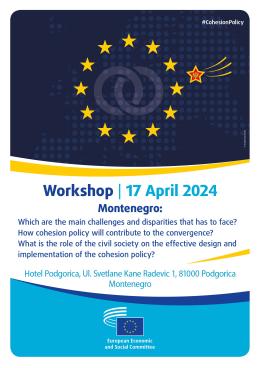
How cohesion policy will contribute to the convergence? What is the role of the civil society on the effective design and implementation of the cohesion funds?
Location
Podgorica
Montenegro
One of the most important aspects of the enlargement process will be the cohesion policy and the structural funds.
In this context, the EESC is preparing an opinion on the role of cohesion policy in upcoming rounds of EU enlargement and it will organise a study visit in Montenegro.
The aim of the study visit on 17/4 is to discuss and explore the possibilities of civil society to respond to the challenges of cohesion policy and how the partnership principle will be implemented. A number of Montenegro officials and civil society actors will then participate in the works of the study visit.