European Economic
and Social Committee
European Economic
and Social Committee
The European Economic and Social Committee (EESC) is the voice of organised civil society in Europe.
Find out more about its role and structure at http://www.eesc.europa.eu/en/about
The EESC issues between 160 and 190 opinions, evaluation and information reports a year.
It also organises several annual initiatives and events with a focus on civil society and citizens’ participation such as the Civil Society Prize, the Civil Society Days, the Your Europe, Your Say youth plenary and the ECI Day.
Find the latest EESC opinions and publications at http://www.eesc.europa.eu/en/our-work/opinions-information-reports/opinions and http://www.eesc.europa.eu/en/our-work/publications-other-work/publications respectively.
The EESC is active in a wide range of areas, from social affairs to economy, energy and sustainability.
Learn more about our policy areas and policy highlights at http://www.eesc.europa.eu/en/policies
The EESC holds nine plenary sessions per year. It also organises many conferences, public hearings and high-level debates related to its work.
Find out more about our upcoming events at http://www.eesc.europa.eu/en/agenda/our-events/upcoming-events
Here you can find news and information about the EESC'swork, including its social media accounts, the EESC Info newsletter, photo galleries and videos.
Read the latest EESC news http://www.eesc.europa.eu/en/news-media/news and press releases http://www.eesc.europa.eu/en/news-media/press-releases
The EESC brings together representatives from all areas of organised civil society, who give their independent advice on EU policies and legislation. The EESC's326 Members are organised into three groups: Employers, Workers and Various Interests.
Find out more about our Members and groups at http://www.eesc.europa.eu/en/members-groups
The EESC has six sections, specialising in concrete topics of relevance to the citizens of the European Union, ranging from social to economic affairs, energy, environment, external relations or the internal market.
Find out more at http://www.eesc.europa.eu/en/sections-other-bodies
Industrisektoren vil møde store udfordringer som følge af EU's foranstaltninger for at afværge klimakrisen. Hvordan kan bæredygtig finansiering styrkes for at bidrage til opfyldelsen af målene i den europæiske grønne pagt og samtidig sikre, at den europæiske industri forbliver konkurrencedygtig? Dette vanskelige spørgsmål vil blive behandlet på et EØSU-webinar den 18. oktober.
Bæredygtig finansiering bør støtte opfyldelsen af målene i den europæiske grønne pagt ved at kanalisere privat investering over i virksomheder og projekter, der bidrager til omstillingen til en klimaneutral, klimarobust, ressourceeffektiv og retfærdig økonomi – en udfordring, som finanssektoren, virksomhederne, de regulerende myndigheder og borgerne tilsammen vil blive stillet over for.
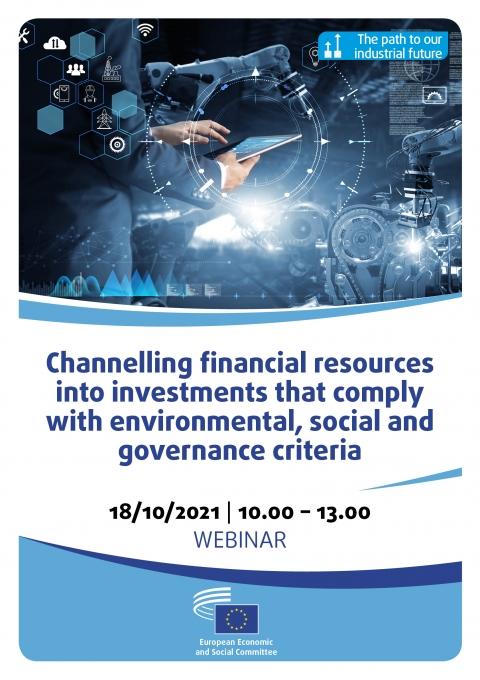
På et webinar med titlen Kanalisering af finansielle ressourcer over i investeringer, der opfylder kriterier inden for miljø, sociale forhold og god selskabsledelse vil paneldeltagere og eksterne interessenter, der deltager via videokonference, drøfte, hvordan man bedst kan skabe disse synergier og udvikle en sådan bæredygtig finansiering.
Webinaret er det tredje i en række af arrangementer vedrørende EU's nye industristrategi, som EØSU har tilrettelagt for at bidrage til udformningen af EU's fremtidige industripolitik efter covid-19-krisen. Rækken af arrangementer vil blive afsluttet med en større konference i marts 2022, hvor EØSU vil drøfte sine konklusioner med det franske EU-formandskab og Kommissionen.
Læs mere om og/eller meld dig til webinaret: link
Læs mere om webinarrækken The path to our industrial future. (dm)