European Economic
and Social Committee
European Economic
and Social Committee
The European Economic and Social Committee (EESC) is the voice of organised civil society in Europe.
Find out more about its role and structure at http://www.eesc.europa.eu/en/about
The EESC issues between 160 and 190 opinions, evaluation and information reports a year.
It also organises several annual initiatives and events with a focus on civil society and citizens’ participation such as the Civil Society Prize, the Civil Society Days, the Your Europe, Your Say youth plenary and the ECI Day.
Find the latest EESC opinions and publications at http://www.eesc.europa.eu/en/our-work/opinions-information-reports/opinions and http://www.eesc.europa.eu/en/our-work/publications-other-work/publications respectively.
The EESC is active in a wide range of areas, from social affairs to economy, energy and sustainability.
Learn more about our policy areas and policy highlights at http://www.eesc.europa.eu/en/policies
The EESC holds nine plenary sessions per year. It also organises many conferences, public hearings and high-level debates related to its work.
Find out more about our upcoming events at http://www.eesc.europa.eu/en/agenda/our-events/upcoming-events
Here you can find news and information about the EESC'swork, including its social media accounts, the EESC Info newsletter, photo galleries and videos.
Read the latest EESC news http://www.eesc.europa.eu/en/news-media/news and press releases http://www.eesc.europa.eu/en/news-media/press-releases
The EESC brings together representatives from all areas of organised civil society, who give their independent advice on EU policies and legislation. The EESC's326 Members are organised into three groups: Employers, Workers and Various Interests.
Find out more about our Members and groups at http://www.eesc.europa.eu/en/members-groups
The EESC has six sections, specialising in concrete topics of relevance to the citizens of the European Union, ranging from social to economic affairs, energy, environment, external relations or the internal market.
Find out more at http://www.eesc.europa.eu/en/sections-other-bodies
Az ipari ágazat a klímaválság elhárítására hozott uniós intézkedések miatt jelentős kihívásokkal fog szembesülni. Hogyan fejleszthető a fenntartható finanszírozás olyan módon, hogy segítse az európai zöld megállapodás céljainak elérését és eközben az európai ipar további versenyképességét is biztosítsa? Az EGSZB október 18-i webináriuma ezt a nehéz kérdést fogja megvitatni.
A fenntartható finanszírozásnak támogatnia kell az európai zöld megállapodás céljainak elérését, a magánberuházásokat olyan vállalatok és projektek felé csatornázva, amelyek támogatják a klímasemleges, az éghajlatváltozás hatásaival szemben ellenállóképes, erőforrás-hatékony és igazságos gazdaság felé történő átmenetet. Ez olyan kihívás, amely a pénzügyi szektor, a vállalkozások, a szabályozó szervek és a polgárok közös erőfeszítését igényli.
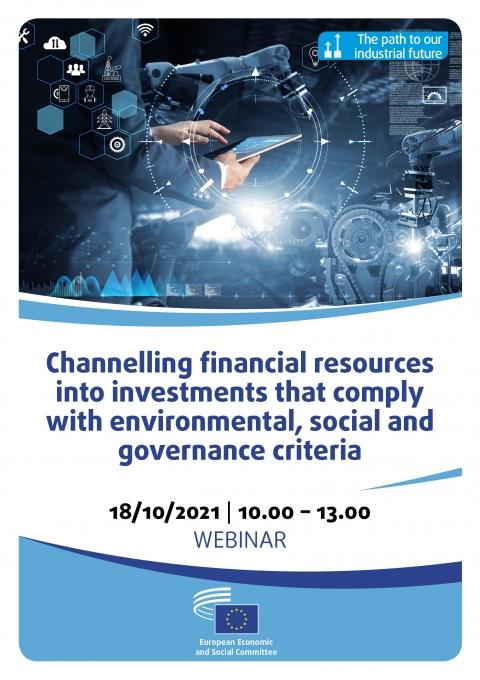
A pénzügyi források környezeti, társadalmi és irányítási szempontoknak megfelelő beruházások felé történő irányítása című webináriumon a vitafórum résztvevői és a videokonferencia útján csatlakozó külső érdekelt felek azt vitatják majd meg, hogy miként lehet ezeket a szinergiákat a legjobban elérni és egy ilyen fenntartható finanszírozást kialakítani.
Ez a webinárium a harmadik azoknak az új uniós iparstratégiáról szóló rendezvényeknek a sorában, amelyeket az EGSZB azért szervez, hogy a jövőre, vagyis a Covid19-válság utáni időkre nézve segítse az EU iparpolitikájának kialakítását. A rendezvénysorozat 2022 márciusában egy nagyobb konferenciával ér véget, amelyen az EGSZB megvitatja megállapításait az EU francia elnökségével és az Európai Bizottsággal.
Jelentkezés a webináriumra, illetve további információk a rendezvényről: link
. További információk „Az ipari jövőnkhöz vezető út” című webináriumsorozatról. (dm)