European Economic
and Social Committee
European Economic
and Social Committee
The European Economic and Social Committee (EESC) is the voice of organised civil society in Europe.
Find out more about its role and structure at http://www.eesc.europa.eu/en/about
The EESC issues between 160 and 190 opinions, evaluation and information reports a year.
It also organises several annual initiatives and events with a focus on civil society and citizens’ participation such as the Civil Society Prize, the Civil Society Days, the Your Europe, Your Say youth plenary and the ECI Day.
Find the latest EESC opinions and publications at http://www.eesc.europa.eu/en/our-work/opinions-information-reports/opinions and http://www.eesc.europa.eu/en/our-work/publications-other-work/publications respectively.
The EESC is active in a wide range of areas, from social affairs to economy, energy and sustainability.
Learn more about our policy areas and policy highlights at http://www.eesc.europa.eu/en/policies
The EESC holds nine plenary sessions per year. It also organises many conferences, public hearings and high-level debates related to its work.
Find out more about our upcoming events at http://www.eesc.europa.eu/en/agenda/our-events/upcoming-events
Here you can find news and information about the EESC'swork, including its social media accounts, the EESC Info newsletter, photo galleries and videos.
Read the latest EESC news http://www.eesc.europa.eu/en/news-media/news and press releases http://www.eesc.europa.eu/en/news-media/press-releases
The EESC brings together representatives from all areas of organised civil society, who give their independent advice on EU policies and legislation. The EESC's326 Members are organised into three groups: Employers, Workers and Various Interests.
Find out more about our Members and groups at http://www.eesc.europa.eu/en/members-groups
The EESC has six sections, specialising in concrete topics of relevance to the citizens of the European Union, ranging from social to economic affairs, energy, environment, external relations or the internal market.
Find out more at http://www.eesc.europa.eu/en/sections-other-bodies
Il settore industriale dovrà affrontare sfide di rilievo a seguito delle misure adottate dall'UE per superare la crisi climatica. Come sviluppare la finanza sostenibile affinché contribuisca a realizzare gli obiettivi del Green Deal europeo garantendo al tempo stesso che l'industria europea resti competitiva? Il 18 ottobre un webinar del CESE affronterà questa spinosa questione.
La finanza sostenibile dovrebbe sostenere la realizzazione degli obiettivi del Green Deal europeo convogliando gli investimenti privati verso le imprese e i progetti che sostengono la transizione verso un'economia climaticamente neutra, resiliente ai cambiamenti climatici, efficiente sotto il profilo delle risorse ed equa: una sfida che il settore finanziario, le imprese, le autorità di regolamentazione e i cittadini dovranno affrontare insieme.
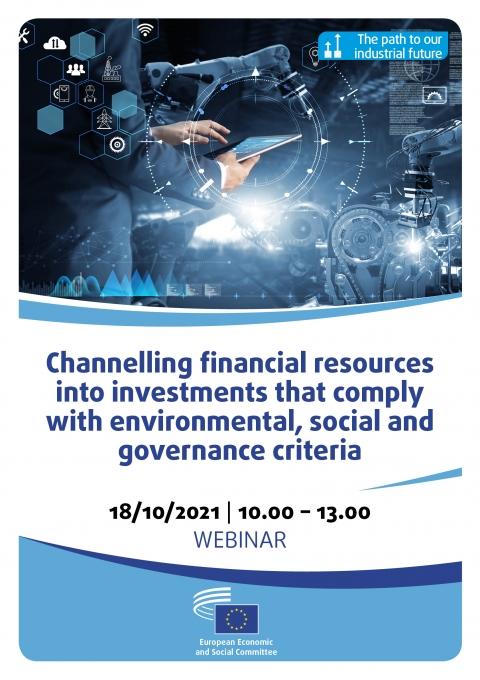
Nel webinar dal titolo Convogliare le risorse finanziarie verso investimenti conformi ai criteri ambientali, sociali e di governance, i partecipanti e i soggetti interessati esterni collegati in videoconferenza discuteranno dei modi migliori per innescare tali sinergie e sviluppare una finanza sostenibile di questo tipo.
Il webinar è il terzo di una serie di eventi su una nuova strategia industriale dell'UE organizzati dal CESE per contribuire a dare forma alla futura politica industriale dell'UE a seguito della crisi della COVID-19. La serie si concluderà con un convegno di alto livello nel marzo 2022, durante il quale il CESE discuterà delle conclusioni raggiunte con la presidenza francese dell'UE e la Commissione europea.
Per saperne di più e/o iscriversi al webinar: link
Per saperne di più sulla serie di webinar "La strada verso il nostro futuro industriale" (dm)