European Economic
and Social Committee
European Economic
and Social Committee
The European Economic and Social Committee (EESC) is the voice of organised civil society in Europe.
Find out more about its role and structure at http://www.eesc.europa.eu/en/about
The EESC issues between 160 and 190 opinions, evaluation and information reports a year.
It also organises several annual initiatives and events with a focus on civil society and citizens’ participation such as the Civil Society Prize, the Civil Society Days, the Your Europe, Your Say youth plenary and the ECI Day.
Find the latest EESC opinions and publications at http://www.eesc.europa.eu/en/our-work/opinions-information-reports/opinions and http://www.eesc.europa.eu/en/our-work/publications-other-work/publications respectively.
The EESC is active in a wide range of areas, from social affairs to economy, energy and sustainability.
Learn more about our policy areas and policy highlights at http://www.eesc.europa.eu/en/policies
The EESC holds nine plenary sessions per year. It also organises many conferences, public hearings and high-level debates related to its work.
Find out more about our upcoming events at http://www.eesc.europa.eu/en/agenda/our-events/upcoming-events
Here you can find news and information about the EESC'swork, including its social media accounts, the EESC Info newsletter, photo galleries and videos.
Read the latest EESC news http://www.eesc.europa.eu/en/news-media/news and press releases http://www.eesc.europa.eu/en/news-media/press-releases
The EESC brings together representatives from all areas of organised civil society, who give their independent advice on EU policies and legislation. The EESC's326 Members are organised into three groups: Employers, Workers and Various Interests.
Find out more about our Members and groups at http://www.eesc.europa.eu/en/members-groups
The EESC has six sections, specialising in concrete topics of relevance to the citizens of the European Union, ranging from social to economic affairs, energy, environment, external relations or the internal market.
Find out more at http://www.eesc.europa.eu/en/sections-other-bodies
O setor da indústria enfrentará grandes desafios em resultado das medidas da UE para combater a crise climática. Como desenvolver um financiamento sustentável que contribua para a consecução dos objetivos do Pacto Ecológico Europeu garantindo, ao mesmo tempo, que a indústria europeia permanece competitiva? O CESE organiza um webinário em 18 de outubro para debater esta questão delicada.
O financiamento sustentável deve apoiar a concretização dos objetivos do Pacto Ecológico Europeu, canalizando investimento privado para empresas e projetos que contribuem para a transição para uma economia sem impacto no clima, resiliente às alterações climáticas, eficiente em termos de recursos e justa – um desafio que tem de ser enfrentado em conjunto pelo setor financeiro, pelas empresas, pelas autoridades reguladoras e pelos cidadãos.
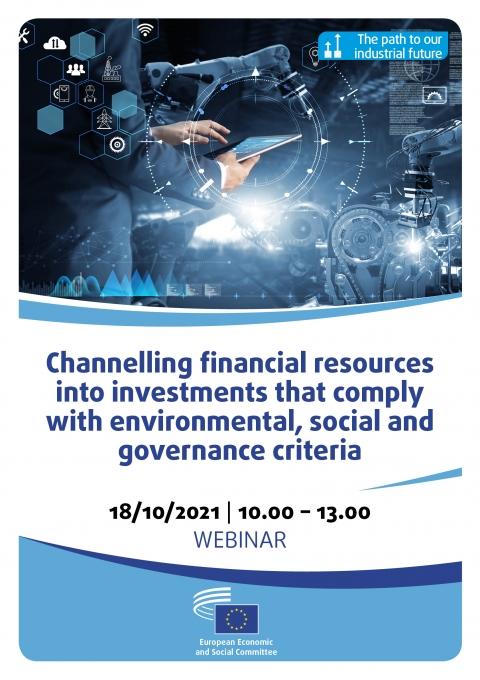
No webinário «Canalizar recursos financeiros para investimentos que cumprem os critérios ambientais, sociais e de governação», os membros do painel e as partes interessadas externas que participam por videoconferência debaterão a melhor forma de alcançar estas sinergias e desenvolver o financiamento sustentável.
O webinário é o terceiro de uma série de eventos sobre a nova estratégia industrial da UE que o CESE tem vindo a organizar para ajudar a definir a futura política industrial da UE na sequência da crise da COVID-19. A série culminará em março de 2022 com uma grande conferência, na qual o CESE debaterá as suas conclusões com a Presidência francesa da UE e a Comissão Europeia.
Para mais informações e/ou inscrever-se no webinário consulte: hiperligação.
Poderá consultar mais informações sobre a série de webinários «O caminho para o futuro da nossa indústria» aqui.