European Economic
and Social Committee
European Economic
and Social Committee
The European Economic and Social Committee (EESC) is the voice of organised civil society in Europe.
Find out more about its role and structure at http://www.eesc.europa.eu/en/about
The EESC issues between 160 and 190 opinions, evaluation and information reports a year.
It also organises several annual initiatives and events with a focus on civil society and citizens’ participation such as the Civil Society Prize, the Civil Society Days, the Your Europe, Your Say youth plenary and the ECI Day.
Find the latest EESC opinions and publications at http://www.eesc.europa.eu/en/our-work/opinions-information-reports/opinions and http://www.eesc.europa.eu/en/our-work/publications-other-work/publications respectively.
The EESC is active in a wide range of areas, from social affairs to economy, energy and sustainability.
Learn more about our policy areas and policy highlights at http://www.eesc.europa.eu/en/policies
The EESC holds nine plenary sessions per year. It also organises many conferences, public hearings and high-level debates related to its work.
Find out more about our upcoming events at http://www.eesc.europa.eu/en/agenda/our-events/upcoming-events
Here you can find news and information about the EESC'swork, including its social media accounts, the EESC Info newsletter, photo galleries and videos.
Read the latest EESC news http://www.eesc.europa.eu/en/news-media/news and press releases http://www.eesc.europa.eu/en/news-media/press-releases
The EESC brings together representatives from all areas of organised civil society, who give their independent advice on EU policies and legislation. The EESC's326 Members are organised into three groups: Employers, Workers and Various Interests.
Find out more about our Members and groups at http://www.eesc.europa.eu/en/members-groups
The EESC has six sections, specialising in concrete topics of relevance to the citizens of the European Union, ranging from social to economic affairs, energy, environment, external relations or the internal market.
Find out more at http://www.eesc.europa.eu/en/sections-other-bodies
Industrijski sektor se bo zaradi ukrepov EU za izhod iz podnebne krize soočil z velikimi izzivi. Kako razviti trajnostno financiranje, da bi prispevali k doseganju ciljev evropskega zelenega dogovora in hkrati ohranili konkurenčnost evropske industrije? EESO bo o tej zapleteni temi razpravljal na spletnem seminarju 18. oktobra.
Trajnostno financiranje bi moralo podpirati doseganje ciljev evropskega zelenega dogovora z usmerjanjem zasebnih naložb v podjetja in projekte, ki si prizadevajo za prehod na gospodarstvo, ki bo podnebno nevtralno, odporno na podnebne spremembe in pravično. S tem izzivom se morajo skupaj spopasti finančni sektor, podjetja, regulativni organi in državljani.
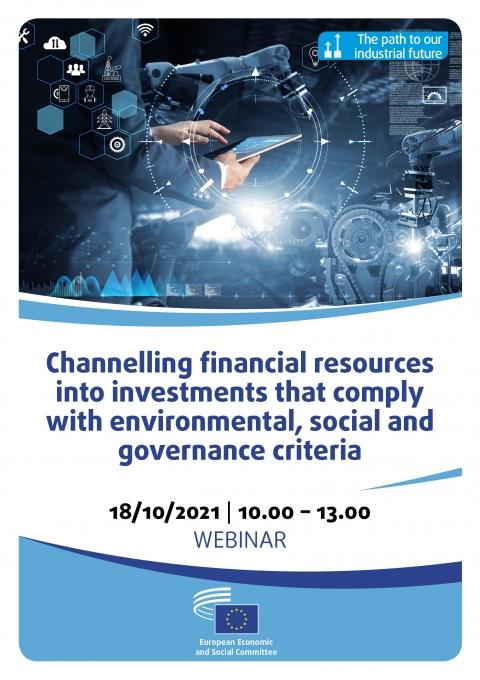
Na seminarju z naslovom Usmerjanje finančnih sredstev v naložbe v skladu z okoljskimi in socialnimi merili ter merili upravljanja bodo govorniki in predstavniki zainteresiranih strani, ki se ga bodo udeležili prek videokonference, razpravljali o tem, kako doseči kar največ sinergij in razvijati takšno trajnostno financiranje.
Ta spletni seminar je tretji v vrsti dogodkov o novi industrijski strategiji EU, ki jih EESO organizira, da bi pomagal oblikovati industrijsko politiko EU za prihodnost po krizi zaradi COVID-19. Zadnji v vrsti teh dogodkov bo velika konferenca marca 2022, na kateri bo EESO o svojih dognanjih razpravljal s francoskim predsedstvom EU in Evropsko komisijo.
Več o spletnem seminarju in/ali prijava nanj: tu
Več o sklopu spletnih seminarjev Pot v prihodnost naše industrije(dm)