European Economic
and Social Committee
European Economic
and Social Committee
The European Economic and Social Committee (EESC) is the voice of organised civil society in Europe.
Find out more about its role and structure at http://www.eesc.europa.eu/en/about
The EESC issues between 160 and 190 opinions, evaluation and information reports a year.
It also organises several annual initiatives and events with a focus on civil society and citizens’ participation such as the Civil Society Prize, the Civil Society Days, the Your Europe, Your Say youth plenary and the ECI Day.
Find the latest EESC opinions and publications at http://www.eesc.europa.eu/en/our-work/opinions-information-reports/opinions and http://www.eesc.europa.eu/en/our-work/publications-other-work/publications respectively.
The EESC is active in a wide range of areas, from social affairs to economy, energy and sustainability.
Learn more about our policy areas and policy highlights at http://www.eesc.europa.eu/en/policies
The EESC holds nine plenary sessions per year. It also organises many conferences, public hearings and high-level debates related to its work.
Find out more about our upcoming events at http://www.eesc.europa.eu/en/agenda/our-events/upcoming-events
Here you can find news and information about the EESC'swork, including its social media accounts, the EESC Info newsletter, photo galleries and videos.
Read the latest EESC news http://www.eesc.europa.eu/en/news-media/news and press releases http://www.eesc.europa.eu/en/news-media/press-releases
The EESC brings together representatives from all areas of organised civil society, who give their independent advice on EU policies and legislation. The EESC's326 Members are organised into three groups: Employers, Workers and Various Interests.
Find out more about our Members and groups at http://www.eesc.europa.eu/en/members-groups
The EESC has six sections, specialising in concrete topics of relevance to the citizens of the European Union, ranging from social to economic affairs, energy, environment, external relations or the internal market.
Find out more at http://www.eesc.europa.eu/en/sections-other-bodies
Le secteur industriel sera confronté à des défis majeurs en raison des mesures prises par l’UE pour remédier à la crise climatique. Comment développer la finance durable pour contribuer à la réalisation des objectifs du pacte vert pour l’Europe tout en veillant à ce que l’industrie européenne reste compétitive? Un webinaire du CESE, le 18 octobre, abordera cette épineuse question.
La finance durable vise à soutenir la réalisation des objectifs du pacte vert pour l’Europe en canalisant les investissements privés vers des entreprises et des projets qui étayent la transition vers une économie juste, neutre pour le climat, résiliente au changement climatique et efficace dans l’utilisation des ressources, un défi auquel doivent faire face conjointement le secteur financier, les entreprises, les autorités de régulation et les citoyens.
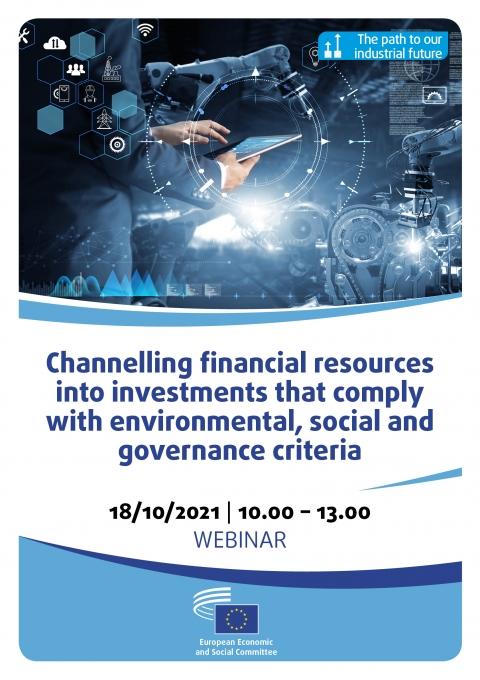
Lors de ce webinaire intitulé «Canaliser les ressources financières vers des investissements conformes aux critères environnementaux, sociaux et de gouvernance», les intervenants et les parties prenantes externes participant via visioconférence discuteront des meilleures manières de parvenir à ces synergies et de développer une telle finance durable.
Ce webinaire est le troisième d’une série de manifestations sur une nouvelle stratégie industrielle de l’UE que le CESE organise pour contribuer à façonner une politique industrielle de l’UE tournée vers l’avenir au lendemain de la crise de la COVID-19. Cette série s’achèvera par une grande conférence en mars 2022, au cours de laquelle le CESE débattra de ses conclusions avec la présidence française de l’UE et la Commission européenne.
Pour en savoir davantage et/ou vous inscrire à ce webinaire: lien
Pour mieux connaître la série de webinaires: La voie vers notre avenir industriel.