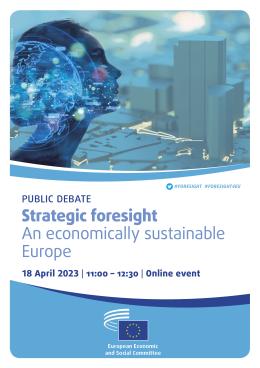
With this debate, the ECO section is providing ex-ante input to the European Commission, in preparation for the upcoming 2023 strategic foresight cycle that wants to shed light on the strategic decisions needed to ensure a socially and economically sustainable Europe with a stronger role in the world in the coming decades.
One of the main conclusions of the 8th Cohesion Report is that although cohesion and convergence among regions in the European Union has improved, there are still remaining gaps especially in less developed regions related with their territorial characteristics. EU islands, mountain areas and sparsely populated areas still face many challenges on their growth and income and disparities exist.
In these regions, there are still a lot of gaps in terms of employment and investment, social exclusion is evident and gender disparities have not diminished.
Download format:
Download — stanovisko EHSV: Main challenges faced by EU islands, and mountainous and sparsely populated areas
The movement of skilled workers out of regions already suffering from lower economic development may further undermine the growth and development potential of these regions. Such a "brain drain" from vulnerable EU regions therefore may contribute to widening territorial disparities, going against the objective of territorial cohesion set out in Article 174 TFEU. Given the cross-border impact of such developments the Commission considers that action at EU level is necessary.
Download format:
Download — stanovisko EHSV: Harnessing talents in EU regions
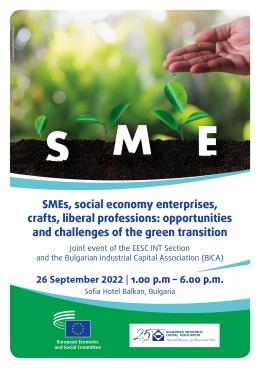
This hearing will focus on topical questions such as the possible avenues to help MSMEs be well informed and prepared to grasp the opportunities of the transition to climate neutrality, coupling it with the possibilities offered by the digitalisation and hedging the current geopolitical risks. It will also take into consideration the challenges faced by the Belgian companies and the opportunities offered to them if they successfully adjust to the climate neutral and digitalised world.
This joint high-level event focused on topical questions such as the challenges faced by Micro, Small, Medium Enterprises (MSMEs) to successfully adjust to the climate neutral and digitalised world. It has also analysed the possible avenues to help MSMEs to be well informed and prepared to grasp the opportunities of the transition to climate neutrality, coupling it with the possibilities offered by the digitalisation and hedging the current geopolitical risks.
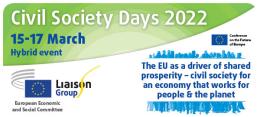
The EU as a driver of shared prosperity – civil society for an economy that works for people & the planet
-
Location
HYBRID EVENT • EESC
Brussels
Belgium
While Europe and its societies are still in the grip of the COVID-19 pandemic and with the Conference on the Future of Europe in its closing stages, the EESC will be holding its annual Civil Society Days in March 2022.
Which contribution to the Conference on the Future of Europe?
Event type
Debate
Location
European Parliament, Room N.1.4
67070 Strasbourg
France
The Conference on the Future of Europe (CoFoE) cannot ignore the model of economic governance created by the social economy. Its existence is based on historical foundations anchored in many European countries where it is both a social and an entrepreneurial dynamic. In some other countries, it is the subject of renewed interest. The European Commission is devoting an action plan to it to unleash its full potential. The European Parliament has already dedicated many reports to it, but today it is necessary to take further steps. The social economy must be promoted in the work of the CoFoE, for its values and democratic principles, for its entrepreneurial diversity and for its role in enhancing active citizenship.