Hearing of the Fundamental Rights and Rule of Law Group
Location
EESC, Rue Belliard 99, 1040 Brussels
Brussels and on line
Belgium
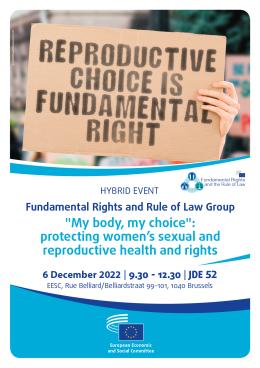
Recent developments in the US and some European countries have shown that rights acquired by women are not irreversible. This particularly applies to sexual and reproductive health and rights. These questions are a matter of individual rights but also of public health, as sexual and reproductive health services are an essential part of comprehensive healthcare provision. Societal debates on the questions tend more and more towards polarisation, at the expense of women who can become deprived of their free and informed choice. The hearing will gather the view of civil society on these developments.
EESC, Room JDE 62 and online | 10:00 - 17:30 | Rue Belliard 99, 1040
Brussels
Belgium
The EESC FRRL Group's annual conference will provide a platform for debate of the European Commission's third Report on the Rule of Law (July 2022), which for the first time entails country specific recommendations.
It will gather EESC Members, civil society representatives (including social partners), EU institutions and other stakeholders to discuss the main developments in the EU in the area of fundamental rights and the rule of law over the past year.
On the occasion of the conference, the FRRL Group will issue its second synthesis report covering the visits carried out in 2020-2021.
As part of its work to prepare an opinion on "Gender lens investing as a way to improve gender equality in the European Union", the European Economic and Social Committee (EESC) is organising a remote public hearing on 23 September 2022 from 9:30 am to 11 am.
The discussion will focus on the EU's role in improving the position of women in receiving capital invested within the Union. It will also address how the EU can step up the implementation of gender budgeting in its annual budget and external financing mechanisms.
The conference is a joint European Commission-EESC event to discuss the annual report on the application of the Charter of Fundamental Rights of the European Union, issued by the Commission in December 2021.
Volunteering happens when volunteer energy (willingness, capability and availability to volunteer) and volunteer opportunities (possibility to volunteer) are matched. The objective of this study is to create classifications of volunteer energy and volunteer opportunities, providing a qualitative overview of the strengths, weaknesses, opportunities and threats (SWOT) that volunteering is facing in the EU.
The conference will cover developments in the EU in the area of fundamental rights and the rule of law in 2020-2021. It will offer a space for dialogue amongst stakeholders, in particular the ones which contributed to country visits led by the EESC Fundamental Rights and Rule of Law (FRRL) Group in 2020-2021 and to the first two European Commission Rule of Law Reports published in 2020 and 2021. The discussions during the day, including in parallel breakout sessions, will focus on the four key themes which structure the European Rule of Law Mechanism: Justice, Media, Corruption, Checks and balances.