585th plenary session with the following guests: Maroš Šefčovič, EC Executive VP for European Green Deal, Interinstitutional Relations and Foresight; Dubravka Šuica, VP of EC and Commissioner for Democracy and Demography and Tatiana Molcean, Under-Secretary General of the UN, Executive Secretary of the United Nations Economic Commission for Europe (UNECE); Edi Rama, Prime Minister of Albania and Milojko Spajić, Prime Minister of Montenegro.
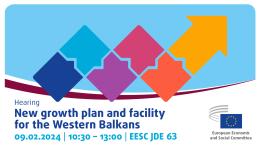
The Commission is proposing a new growth plan for the Western Balkans based on four pillars, aimed at:
Enhancing economic integration with the European Union’s single market, subject to the Western Balkans aligning with single market rules and opening the relevant sectors ....
CEDEFOP and the EESC are jointly organizing the "Fifth Policy learning forum on Upskilling pathways: a vision for the future". The Forum is organised in a context where all adults, regardless of their socio-economic background, labour market status and qualifications deserve the opportunity to constantly update and acquire new skills to keep up with rapidly changing work realities, manage ever more frequent transitions in the labour market and to thrive in their personal lives and career.
The EESC organised a public hearing in the process of drafting its opinion (INT/1039) on the Commission's 2023 Strategic Foresight Report (SFR) focusing on 'Sustainability and people's wellbeing at the hearth of Europe's Open Strategic Autonomy"
The European Commission announced the Defence of Democracy Package as a way to promote free and fair elections, to fight disinformation, and to develop civic space and citizen participation. The initiative has raised much interest but also concerns amongst civil society actors fearing that aspects addressing interference from non-EU countries could affect civic space. Participating stakeholders are invited to discuss the content of the package to feed into the related EESC opinion.
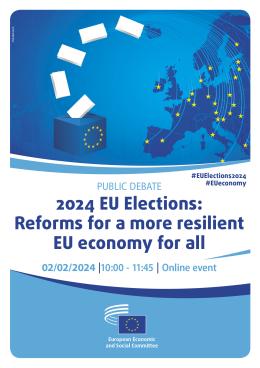
This public hearing is being organised as part of the preparation of the exploratory opinion ECO/630 on "Boosting long-term inclusive growth through reforms and investment" requested by the Belgian Presidency of the Council of the EU. It focuses on how to foster upwards social convergence and cohesion, in an economic governance framework defined around debt sustainability, productive investments and reforms. It also looks at the implications of such a framework for the European Semester and the strengthening of the European Pillar of Social Rights.
Priorities for the Future Leadership of the European Union to Achieve the Sustainable Development Goals in a Fragmented and Multipolar World
Location
Brussels
Belgium
The Sustainable Development Solutions Network and the EESC will host a high-level hybrid event on Europe’s future and the SDGs during the meeting of the EESC NAT Section. The event will aim to provide relevant contributions on how the EU can strengthen its SDG leadership in the context of the upcoming European elections in June 2024 and UN Summit of the Future in September 2024. The event will notably feature the launch of the 5th edition of the Europe Sustainable Development Report which tracks annually since 2019 the performance of all EU member states and partner countries on the SDGs and is co-designed with civil society. The discussions will also aim to highlight opportunities and mechanisms for further engagement with civil society organizations and the private sector to advance the SDGs in Europe.
The Commission's proposal Business in Europe: Framework for Income Taxation (BEFIT) deals with a new single set of rules to determine the tax base of groups of companies, and is aimed at reducing tax compliance costs for large businesses operating across borders and making it easier for national authorities to determine which taxes are due. Directly linked to BEFIT is the proposal on transfer pricing, with the purpose to harmonise transfer pricing rules of Member States and to ensure a common application of the arm's-length principle within the EU. The new framework builds on the previous experiences from the common consolidated corporate tax base CCCTB, the OECD/G20 international tax agreement concerning the global minimum level of taxation, and on the Pillar Two Directive adopted at the end of 2022.
This meeting is hosted by the European Economic and Social Committee (EESC), as a follow-up of its call for an EU Blue Deal. It is organised in partnership with the European Parliament Intergroup on “Climate Change, Biodiversity and Sustainable Development” and the Compagnie Nationale du Rhône (CNR).