
European Economic
and Social Committee
Building the future: how innovation can transform Europe's construction sector

The European Economic and Social Committee hosted a hearing on how to foster innovation and digitalisation in the construction sector. Experts and industry representatives discussed the main barriers to innovation, from outdated regulations and lack of funding to skills shortages, and explored how digital tools, new materials and smarter rules could help modernise the sector.
The construction sector is a strategic pillar of the EU. It plays a fundamental role in shaping our cities, making our transport connections more efficient, modernising hospitals and creating welcoming schools. But it is also a key enabler of the green and digital transitions. It shapes Europe’s housing, transport, energy and climate-resilient infrastructure, and underpins multiple strategic value chains.
Like any other sector, construction can greatly benefit from digitalisation and innovation. However, many of these benefits are still held back by outdated regulations, insufficient funding and weak public support. For this reason, the Consultative Commission on Industrial Change (CCMI) of the European Economic and Social Committee convened a hearing on 29 September to advance policy discussions on "Fostering innovation and digitalisation in the construction sector."
The discussions examined the structural barriers that continue to hinder innovation in the sector – including skills shortages, market fragmentation, limited access to digital tools and uneven regulatory frameworks – and explored potential solutions.
Turning promising ideas into reality
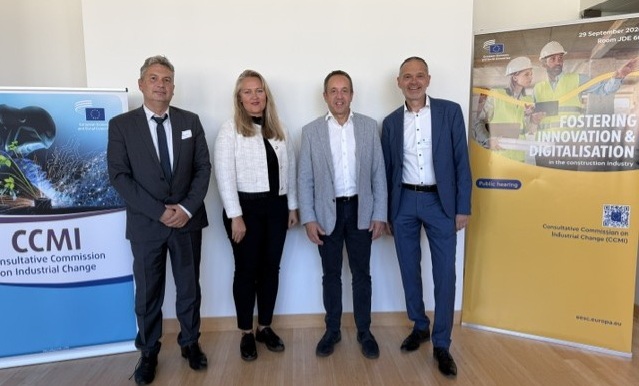
Construction shapes the places where people live and work, providing schools, hospitals, transport and energy infrastructure, while also representing a major source of employment across Europe, said Alain Coheur, president of the CCMI. The question of innovation in the sector is therefore a practical one: how Europe can build and renovate what people need. Mr Coheur stressed that, despite the abundance of promising ideas, their uptake remains uneven, as many companies, particularly small and medium-sized ones, face high upfront costs, fragmented rules and shortages of workers with the right skills.
Baiba Miltoviča, the EESC rapporteur for the opinion on Fostering innovation and digitalisation in the construction industry, told the hearing that raising public awareness is essential to encourage innovation in construction processes. New and recycled materials and other innovative solutions are relevant not only to public authorities, but also to individuals and other private clients. Raising awareness could therefore help change the perception of construction as an outdated sector associated with old practices and potentially dangerous materials, while highlighting the innovation already transforming the industry.
According to Domenico Campogrande, CCMI delegate and co-rapporteur for the CCMI opinion on innovation and digitalisation in construction, the sector is a highly complex ecosystem encompassing design, product manufacturing, machinery, the building process itself, workers and end users. This complexity means that different stakeholders may require different approaches to innovation.
Digitalising construction projects
Innovation can also be supported by making life simpler for construction companies, which sometimes have to fill in forms providing information and applying for permits at several stages of a project, often having to enter data they have already provided. Natalia Żebrowska, Head of the Construction unit at the European Commission’s DG GROW, explained that the Commission’s aim is to develop a digital system for sharing information throughout the life cycle of a construction project. Information provided by producers and manufacturers about products used on a construction site could then be reused throughout the project, rather than having to be entered repeatedly at different stages.
She added that the Commission is also working to make it easier for new products to enter the market. This includes modernising harmonised technical standards so that they can accommodate innovative products and technologies that did not exist when some of the standards were first developed 30 or 40 years ago. The work also aims to ensure that recycled products can be placed on the market.
Updating the rules for new materials
Mathew Vola, a Fellow and director at engineering consultancy Arup, where he is Global Skills Leader for Computational Design, and a representative of Engineers for Europe (E4E), also underlined the importance of an appropriate regulatory framework for the adoption of new materials and manufacturing techniques. While renewable materials such as timber are gaining momentum, regulatory uncertainty remains, including in areas such as fire safety and moisture. A common European approach could give the industry greater confidence to adopt these materials and stimulate further innovation.
Mr Vola noted that the issue goes beyond renewable materials. Existing rules for conventional materials such as concrete can also be highly prescriptive. Some codes, for example, require the use of 300 kilogrammes of cement per tonne even when, according to Mr Vola, such quantities are no longer technically necessary.
Sharing the risks of innovation
But to innovate, companies need funding and the trust of public institutions. Ulrik Branner, CEO and Founder of Sitehub.dk and vice-president of the European Construction Industry Federation (FIEC), argued that one reason construction companies are not innovating faster is that many projects are still awarded primarily on the basis of the lowest price, while risks are pushed down the supply chain.
Innovation inevitably involves trying solutions that may not work immediately and improving them over time. Fostering innovation therefore requires risks to be shared and companies to be allowed to learn from mistakes, something that is difficult under a procurement model focused predominantly on the lowest price.
Attracting a new generation of workers
A healthy construction sector also needs workers, but attracting them is becoming increasingly difficult. Innovation can help address this problem too. Giuseppe Perretti, policy officer at the European Federation of Building and Woodworkers (EFBW), said digitalisation and new technologies could be part of the solution. Robotics and automation, for example, can support workers and improve production processes.
Digital tools could also make the sector more attractive to younger generations by increasing demand for digital skills. However, Mr Perretti stressed that technological innovation needs to be accompanied by measures addressing poor working conditions, precarious employment, subcontracting and enforcement.
Work organisation
Recommended for you
Цифровият преход трябва да бъде справедлив: правата на човека и човешкият надзор трябва да продължат да заемат централно място
News
Европейският икономически и социален комитет (ЕИСК) привлича вниманието върху възможностите, които предлага цифровата революция, но предупреждава и за заплахите: ако бъдат приложени твърде бързо,…
Организациите на гражданското общество са първите точки за контакт по време на криза и те могат да помогнат за сплотеността на ЕС
News
На годишното си заседание Европейският икономически и социален комитет (ЕИСК) и националните икономически и социални съвети на ЕС обсъдиха интеграцията на хората, бягащи от войната в Украйна,…
YEYS! 2023: Младите хора искат по-прозрачен, цифров и опростен ЕС
News
На 23 и 24 март Европейският икономически и социален комитет (ЕИСК) беше домакин на 14-ото издание на проявата „Твоята Европа, твоето мнение!“ (YEYS!), която събра в Брюксел 105 ученици от 35 училища…
Участници от гражданското общество — незаменими съюзници за изпълнението на целите за устойчиво развитие
News
На пленарната си сесия през март Европейският икономически и социален комитет (ЕИСК) прие посланика Лъчезара Стоева, председател на Икономическия и социален съвет на ООН. Посланик Стоева изрази…
ЕС ще бъде по-конкурентоспособен, като подкрепя малките и средните предприятия
News
По време на пленарната си сесия през февруари Европейският икономически и социален комитет (ЕИСК) зае твърда позиция в полза на създаването на по-добра бизнес среда за МСП в Европа: законодателството…