The forthcoming Presidency of the Council of the EU (Germany), aims to further discuss and analyze the policy objective 1 under the Common Provisions Regulation for cohesion policy that refers to '' a smarter Europe by promoting innovative and smart economic transformation''. In this context, the Presidency has asked the EESC to provide an opinion on how the structural measures and cohesion policy programmes can help in this process. The Presidency plans to present the key findings of this discussion in a High-level conference that will take place on 29th of September where also the opinion of EESC will be discussed.
Download — Mnenje EESO: The role of EU structural and cohesion policy in driving forward the transformation of the economy in an innovative and smart manner (Exploratory opinion at the request of the German presidency)
The European Economic and Social Committee welcomes the Commission's proposal to ensure the continuation of two bilateral cooperation programmes involving Ireland namely the PEACE IV (Ireland-United Kingdom) and the United Kingdom-Ireland programme, after UK's intention to withdraw from the Union pursuant to art. 50 of the Treaty on European Union.
Download — Mnenje EESO: PEACE IV - Continuation of the cooperation programmes
The objective of the public hearing is to examine how cohesion policy can more effectively address housing affordability challenges to advance its core goals of economic, social and territorial cohesion. The participants will explore how strategic housing investments can stimulate regional economic development, enhance competitiveness, improve labour market efficiency, and reduce territorial disparities. The aim is to provide concrete recommendations for improving the effectiveness of existing instruments for the remainder of the 2021-2027 period and developing a more comprehensive approach to affordable housing within the post-2027 cohesion policy framework.
Public hearing with Polish civil society and policy makers
Event type
Public hearing
Location
Online event
ul. Wspólna 2/4
00-926 Warszawa
Warsaw
Poland
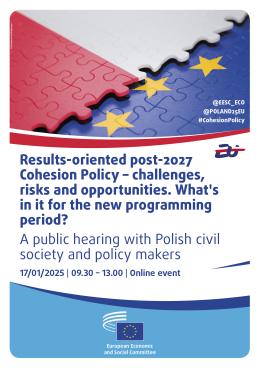
In the context of the ongoing exploratory opinion, requested by the Polish Presidency, to examine how civil society actors can make use of a results-orientation approach in cohesion policy in the next programming period, the EESC is organizing a hearing in Warsaw on 17 January 2025. The hearing will be important as the EESC will explore how civil society and local actors understand the concept of a results-orientation approach to cohesion policy, to which degree they are prepared and if they have the administrative capacity to implement it.
The hearing is co-organized with the Polish Presidency of the Council of the EU and it has the patronage of the Polish Presidency. The venue is the premises of the Ministry of Development Funds and Regional Policy of Poland.
The EESC is organising this public debat to discuss how civil society partners can use a results-orientation approach in cohesion policy for the next programming period. The principles of multi-level governance and shared management are contradictory or complementary to the results-focused cohesion policy ?
Lessons learned from the first years of the implementation of the programming period 2021-2027
Event type
Debate
Location
Online event
Belgium
Public debate on 9th Cohesion report: Lessons learned from the first years of the implementation of the programming period 2021-2027, in the framework of the ECO section meeting.