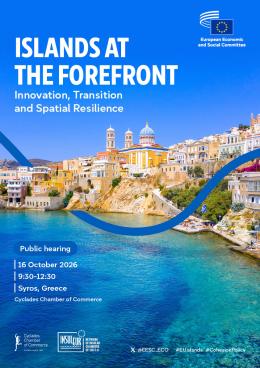
As part of the preparation of the EESC opinion on an EU Strategy for Islands, the European Economic and Social Committee, in cooperation with INSULEUR, will hold a public hearing in Syros, at the heart of the Cyclades. The hearing aims to bring together local and regional authorities, organised civil society, businesses, academia and citizens to exchange views on both the challenges and the untapped opportunities facing Europe's islands. Beyond discussing issues such as connectivity, demographic change, access to services and climate resilience, the event will highlight the unique assets of islands like Syros, including their strategic location, cultural heritage, blue economy potential, innovation capacity, renewable energy opportunities and sustainable tourism. The insights gathered will contribute directly to the EESC opinion by ensuring that the voices, experiences and aspirations of island communities are reflected in future EU policies and in the implementation of the first European Strategy for Islands which was adopted in June 2026.
The EESC calls for the establishment of a dedicated Union strategy for islands (Islands Pact), supported by a specific legislative framework (Islands Act). That framework should be accompanied by a formal strategy and provide for the effective implementation of an ‘insularity clause’, with a view to systematically integrating the specific needs and constraints of islands into Union policies on cohesion, transport, energy, state aid, the environment and maritime affairs.
The objective of the public hearing is to examine how cohesion policy can more effectively address housing affordability challenges to advance its core goals of economic, social and territorial cohesion. The participants will explore how strategic housing investments can stimulate regional economic development, enhance competitiveness, improve labour market efficiency, and reduce territorial disparities. The aim is to provide concrete recommendations for improving the effectiveness of existing instruments for the remainder of the 2021-2027 period and developing a more comprehensive approach to affordable housing within the post-2027 cohesion policy framework.
Public hearing with Polish civil society and policy makers
Event type
Public hearing
Location
Online event
ul. Wspólna 2/4
00-926 Warszawa
Warsaw
Poland
In the context of the ongoing exploratory opinion, requested by the Polish Presidency, to examine how civil society actors can make use of a results-orientation approach in cohesion policy in the next programming period, the EESC is organizing a hearing in Warsaw on 17 January 2025. The hearing will be important as the EESC will explore how civil society and local actors understand the concept of a results-orientation approach to cohesion policy, to which degree they are prepared and if they have the administrative capacity to implement it.
The hearing is co-organized with the Polish Presidency of the Council of the EU and it has the patronage of the Polish Presidency. The venue is the premises of the Ministry of Development Funds and Regional Policy of Poland.
The EESC is organising this public debat to discuss how civil society partners can use a results-orientation approach in cohesion policy for the next programming period. The principles of multi-level governance and shared management are contradictory or complementary to the results-focused cohesion policy ?
Focussing on five EU Member States (Belgium, Bulgaria, France, Italy and Portugal), this study aims to provide a comprehensive overview of the role and increasing significance of the national Economic and Social Councils (NESCs), while also putting forward a set of policy recommendations on how to involve the NESCs more constructively, and how to make sure that the EESC's relationship with the NESCs, and henceforth its involvement as the EU's institutional bridge with civil society, can be further strengthened.
The Commission is proposing amendments to three EU regulations to ensure that EU funds can be quickly mobilised in support of post-disaster recovery.
The amendments concern theRegulations governing the European Regional Development Fund (ERDF) and the Cohesion Fund (CF), and the European Social FundPlus (ESF+), for the 2021-2027 programming period.
These proposals come as a direct response to the floods affecting Central and Eastern European countries and wildfires in Portugal in September 2024 and include injecting liquidity with increased pre- and co-financing under Cohesion Policy.