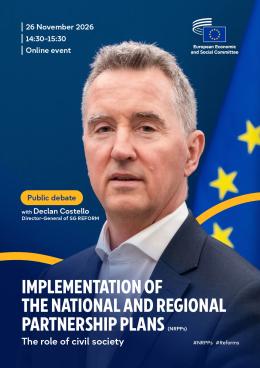
The ECO Section will hold a policy debate with Declan Costello, Director-General of SG REFORM, on the implementation of the National and Regional Partnership Plans (NRPPs) under the next EU Multiannual Financial Framework (2028–2034). The discussion will focus on the role of organised civil society in the design, implementation and monitoring of the NRPPs, with particular emphasis on safeguarding the partnership principle and multilevel governance.
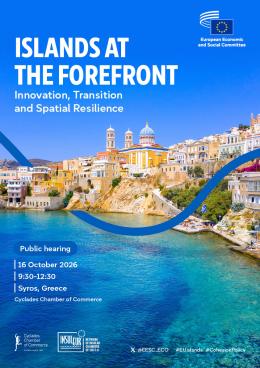
As part of the preparation of the EESC opinion on an EU Strategy for Islands, the European Economic and Social Committee, in cooperation with INSULEUR, will hold a public hearing in Syros, at the heart of the Cyclades. The hearing aims to bring together local and regional authorities, organised civil society, businesses, academia and citizens to exchange views on both the challenges and the untapped opportunities facing Europe's islands.
The European Commission presented a new Communication on islands on 10th of June as a result of the public consultation in which the EESC has contributed with the exploratory opinion requested by the Cypriot Presidency of the Council of the EU.
The EESC calls for the establishment of a dedicated Union strategy for islands (Islands Pact), supported by a specific legislative framework (Islands Act). That framework should be accompanied by a formal strategy and provide for the effective implementation of an ‘insularity clause’, with a view to systematically integrating the specific needs and constraints of islands into Union policies on cohesion, transport, energy, state aid, the environment and maritime affairs.
The objective of the public hearing is to examine how cohesion policy can more effectively address housing affordability challenges to advance its core goals of economic, social and territorial cohesion. The participants will explore how strategic housing investments can stimulate regional economic development, enhance competitiveness, improve labour market efficiency, and reduce territorial disparities. The aim is to provide concrete recommendations for improving the effectiveness of existing instruments for the remainder of the 2021-2027 period and developing a more comprehensive approach to affordable housing within the post-2027 cohesion policy framework.
Public hearing with Polish civil society and policy makers
Event type
Public hearing
Location
Online event
ul. Wspólna 2/4
00-926 Warszawa
Warsaw
Poland
In the context of the ongoing exploratory opinion, requested by the Polish Presidency, to examine how civil society actors can make use of a results-orientation approach in cohesion policy in the next programming period, the EESC is organizing a hearing in Warsaw on 17 January 2025. The hearing will be important as the EESC will explore how civil society and local actors understand the concept of a results-orientation approach to cohesion policy, to which degree they are prepared and if they have the administrative capacity to implement it.
The hearing is co-organized with the Polish Presidency of the Council of the EU and it has the patronage of the Polish Presidency. The venue is the premises of the Ministry of Development Funds and Regional Policy of Poland.