
European Economic
and Social Committee
New competitiveness deal should complement the EU’s green transformation
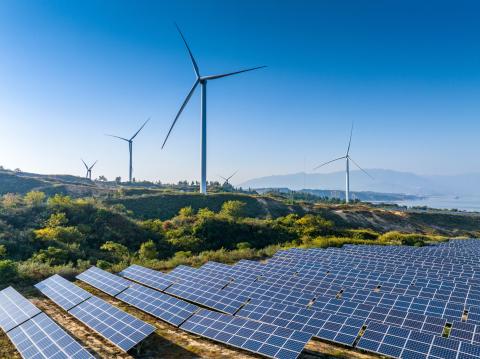
The European Economic and Social Committee (EESC) fully supports the objectives of the European Green Deal. However, it urgently calls for attention to be paid to the negative aspects of the deal, which have affected employment and EU competitiveness.
The European Union needs a braver and more ambitious approach and a clear implementation framework to ensure that the European Green Deal is a success from both a climate and a socio-economic point of view. In its opinion on The Clean Transition Dialogues – Stocktaking, the EESC also stresses the urgent need for a new competitiveness deal if the EU is to achieve its ambitious Green Deal goals while maintaining a vibrant economy, social cohesion and quality jobs for workers in the Union. Furthermore, the EU must acknowledge that some of its core policies have been counterproductive and have led to a plunge in EU-produced products, which are now being replaced by much more carbon-intensive imports, and take steps to rectify this trend that is not only bad for the climate, but also for the EU’s economy and security.
The EESC stresses that the new competitiveness deal should include stronger protections against carbon leakage in order to maintain a level playing field for European companies. This includes maintaining free emission trading system allocations for sectors covered by the carbon border adjustment mechanism until a workable solution for exports and adequate anti-circumvention measures can be put in place. Permitting times should also be much faster, (including for judicial reviews of environmental objections), and substantial investments made in distribution and transmission grids and in harbours to facilitate the development of offshore renewables. The EU should also focus on a technology-neutral energy policy that delivers greater long-term stability and globally competitive prices. The EU must also invest in stable, low-carbon sources during the transition.
Industrial retail electricity prices in the EU are currently 2-3 times higher than in the US (2021-2023), whereas historically they have settled at around 1.5-2 times higher. Gas prices are 3-6 times higher, compared to 2-3 times higher historically, with an even wider gap with prices in China. The EESC therefore proposes that before closing down an existing energy source, Member States carry out a full impact assessment (that includes social consequences) and require that a more sustainable energy source be provided. In addition, Member States should introduce support schemes to break down the remaining barriers to renewable energy power purchase agreements, as provided for in the Renewable Energy Directive. This should include instruments to make renewable electricity more reliable. The indirect cost compensation scheme should also be maintained in order to partially offset the additional increase in electricity prices caused by the emissions trading system.
Given the importance of water for industrial and agricultural production, an EU strategy is needed to increase water security – a sentiment which is echoed in the EESC’s call for a Blue Deal. The EESC stresses that without substantial investments in water, energy, electricity grids and offshore energy infrastructure, Europe will not meet its Green Deal targets and will fall behind in terms of competitiveness, with serious consequences on employment. Furthermore, given that the construction sector is the second-largest industrial ecosystem in the EU, and that buildings account for 40% of energy consumption, this sector has enormous potential to contribute to the Green Deal. Therefore, more needs to be done to promote green public procurement, the reuse of primary materials and recycling.
In addition, the EESC calls for significantly reducing both red tape and reporting requirements, in line with the Commission’s proposals, and for a dedicated financing instrument to support the production of critical raw materials and net-zero technologies. The EESC also calls for incentives to promote cleaner modes of transport in cities, including public transport, walking, cycling and clean vehicles. Finally, the EESC underlines that the EU’s just transition framework should be used to the fullest extent to ensure the re-skilling and up-skilling of European workers for a socially inclusive and economically efficient green and competitive transition in the EU.
Recommended for you
Decision repealing Directive 89/629/EEC
Opinion
HOOFDPUNTEN Het EESC: stemt in met het voorstel, heeft er geen commentaar op en heeft daarom besloten er een positief advies over uit te brengen.
RePowerEU Plan
Opinion
HOOFDPUNTEN Het EESC: beschouwt het REPowerEU-plan van de Europese Commissie als een stap in de goede richting om de EU onafhankelijk te maken van de Russische gas- en olielevering; wijst erop…
Individual and collective energy self-consumption as a factor in the fight for the green and energy transition, and for economic and social balance
Opinion
Individueel en collectief zelfverbruik van energie als factor in de strijd voor de groene en energietransitie en voor economisch en sociaal evenwicht Hoofdpunten Het EESC: is van mening dat de…
Equity and efficiency considerations for maritime transportation
Opinion
Rechtvaardigheid en efficiëntie in het zeevervoer Hoofdpunten Het EESC: onderstreept dat de groene transitie van de scheepvaartsector rekening moet houden met landspecifieke, sectorspecifieke en…
Open Dag van de Europese instellingen
Event
Op zaterdag 6 mei kon het Europees Economisch en Sociaal Comité (EESC) samen met de andere EU-instellingen in Brussel voor het eerst sinds de COVID-19-crisis zijn deuren weer openen ter gelegenheid…