
European Economic
and Social Committee
European Economic and Social Committee calls for an ethical and safe metaverse for business and society
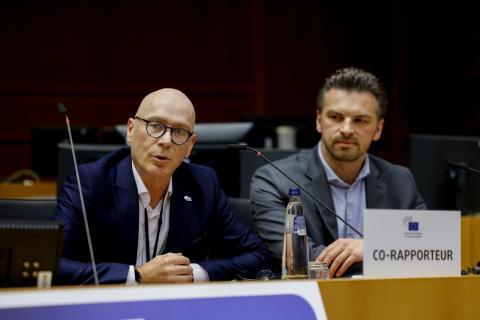
At its April plenary, the European Economic and Social Committee (EESC) adopted an exploratory opinion requested by the European Commission to gather input from civil society on the impact of the metaverse on society. The document, which examines the business environment, working conditions and development of civil society, suggests that the metaverse will bring with it both opportunities and risks that the EU must address rapidly to create an ethical, safe, and inclusive virtual environment for all.
From a technical standpoint, the metaverse is built on interconnected virtual worlds, created using various technologies, including 3D modelling, web 3.0, and augmented and virtual reality. It also involves economic and commercial components, such as virtual currencies, services and marketplaces, which rely on blockchain and other decentralised technologies to ensure transparency and security.
The EESC rapporteur for the opinion, Martin Böhme, stressed that the metaverse and virtual worlds are going to have substantial effect on our lives. There are opportunities that come with it, as well as potential pitfalls to anticipate. It creates challenges for employers, employees and civil society, and Europe needs to start addressing them.
The metaverse has already shown its potential to provide solutions to unsolved problems and enable products to be manufactured at a lower cost and in less time, while improving quality, reducing risk and increasing efficiency. It is also expected to have a positive impact on the environment and climate change by enabling remote working on a new level, reducing the need for physical travel and reducing carbon emissions.
However, virtual worlds pose several risks, especially for children and vulnerable groups. The Committee calls on platform operators to put in place strict control mechanisms to filter and remove harmful content and safeguards to prevent harassment and abuse, as users have reported increasing levels of offensive and undesirable behaviours, including harassment, data exploitation, unregulated gambling, threats of violence, and grooming of minors. Addiction to simulated reality, privacy, and mental health issues also feature as key concerns among users worldwide.
The Committee notes that the future of the metaverse is comprised of multiple dimensions, including consumer, enterprise, and industrial metaverses. The industrial metaverse holds significant potential for European companies looking to optimise their operations, gather data and improve performance. However, the opinion highlights several challenges that come with the metaverse, such as the need for increased acceptance of these new technologies, the urgent need to reskill the workforce, and the need for ethical and safe experiences.
The EESC also believes that the legislation currently in force may not be sufficient to regulate virtual worlds and calls on the EU institutions to ensure that existing real-world legislation and taxation is respected in the virtual world and that new measures are taken to regulate the metaverse and address its specific needs.
Building metaverses for business requires particular kinds of competencies, and Europe must strive to become once again a welcoming community for researchers to stay ahead of the curve
said EESC co-rapporteur Hervé Jeannin, Europe has already missed out on AI, robotics and electric batteries. We must stay ahead of the game with these new technologies.
A second EESC opinion on the metaverse is already in the works and is planned for adoption by the Committee plenary assembly in the second half of the year.
Work organisation
Related content
Downloads
-
European Economic and Social Committee calls for an ethical and safe metaverse for business and society
Recommended for you
Decision repealing Directive 89/629/EEC
Opinion
HOOFDPUNTEN Het EESC: stemt in met het voorstel, heeft er geen commentaar op en heeft daarom besloten er een positief advies over uit te brengen.
RePowerEU Plan
Opinion
HOOFDPUNTEN Het EESC: beschouwt het REPowerEU-plan van de Europese Commissie als een stap in de goede richting om de EU onafhankelijk te maken van de Russische gas- en olielevering; wijst erop…
Individual and collective energy self-consumption as a factor in the fight for the green and energy transition, and for economic and social balance
Opinion
Individueel en collectief zelfverbruik van energie als factor in de strijd voor de groene en energietransitie en voor economisch en sociaal evenwicht Hoofdpunten Het EESC: is van mening dat de…
Equity and efficiency considerations for maritime transportation
Opinion
Rechtvaardigheid en efficiëntie in het zeevervoer Hoofdpunten Het EESC: onderstreept dat de groene transitie van de scheepvaartsector rekening moet houden met landspecifieke, sectorspecifieke en…
Open Dag van de Europese instellingen
Event
Op zaterdag 6 mei kon het Europees Economisch en Sociaal Comité (EESC) samen met de andere EU-instellingen in Brussel voor het eerst sinds de COVID-19-crisis zijn deuren weer openen ter gelegenheid…