As the European Union approaches a pivotal review of its social policy agenda, a new report requested by the European Economic and Social Committee (EESC) offers a detailed snapshot of the state of play for the European Pillar of Social Rights (EPSR). The findings highlight both significant advances and persistent challenges as the EU strives to meet its ambitious 2030 social targets.
The EESC regrets, that the Commission has once again refrained from presenting the Annual Sustainable Growth Survey (ASGS) and stresses that sustainable economic growth is a necessary condition for Europe to meet its multiple commitments, welcomes the European Macroeconomic Report, which provides a deep dive into the underlying structural challenges facing the EU and the new recommendation on human capital, which is a crucial element in filling the EU technological gap, also taking into account the EU demographic challenge. The Committee reiterates its call for more robust commonfiscal capacity, supported by targeted issuances of joint debt, to help fill this growing gap in public investment, and for permanent macroeconomic stabilisation instruments to address shocks.
Download format:
Download — Opinjoni tal-KESE: 2026 European Semester – Autumn Package
This study examines how social partners and civil society organisations in six Member States — Italy, Austria, Hungary, Poland, Portugal and Sweden — view the effectiveness of current policies in raising employment levels and increasing adult participation in training. It also puts forward recommendations for improving policy outcomes.
This report, prepared for the EESC Workers' Group, analyses the question of defence in the European Union within its current state of play and its insertion into the broader debate of security
This study, commissioned by the European Economic and Social Committee, examines the state of implementation of the European Pillar of Social Rights and its Action Plan in 2024
At its September 2025 plenary session, the European Economic and Social Committee (EESC) adopted an opinion on the EU Employment Guidelines, urging Member States to accelerate efforts on inclusion, skills, and productivity to ensure a fair and competitive labour market for all.
At its September 2025 plenary session, the European Economic and Social Committee (EESC) adopted a pioneering opinion on the use of Artificial Intelligence (AI) and Big Data in rare disease diagnosis and treatment. It sets out a comprehensive vision for harnessing digital innovation to improve the lives of rare disease patients.
At its September 2025 plenary session, the European Economic and Social Committee (EESC) adopted a forward-looking opinion on achieving the EU’s “Zero Deaths” goal in workplace health and safety. It sets out a comprehensive vision for occupational safety and health (OSH) in a rapidly changing world of work.
The EESC Section for Employment, Social Affairs and Citizenship (SOC) organised a hearing on "Accessible and Affordable Housing for All: Ensuring Inclusion of Persons with Disabilities in the EU". It brought together voices from the EU institutions, civil society, disability organisations and housing experts to address the urgent challenge of affordable and accessible housing across Europe.
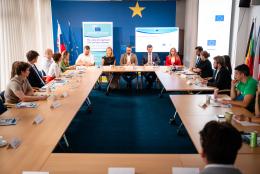
Introduced by the European Economic and Social Committee (EESC) in 2024, the Youth Test is now being recognised as a pioneering method for integrating youth voices into policy-making. A recent roundtable in Bratislava brought together young leaders, policymakers and civil society to examine how the Youth Test can be meaningfully integrated into national decision-making processes.