As the European Union approaches a pivotal review of its social policy agenda, a new report requested by the European Economic and Social Committee (EESC) offers a detailed snapshot of the state of play for the European Pillar of Social Rights (EPSR). The findings highlight both significant advances and persistent challenges as the EU strives to meet its ambitious 2030 social targets.
At its September 2025 plenary session, the European Economic and Social Committee (EESC) adopted an opinion on the EU Employment Guidelines, urging Member States to accelerate efforts on inclusion, skills, and productivity to ensure a fair and competitive labour market for all.
At its September 2025 plenary session, the European Economic and Social Committee (EESC) adopted a pioneering opinion on the use of Artificial Intelligence (AI) and Big Data in rare disease diagnosis and treatment. It sets out a comprehensive vision for harnessing digital innovation to improve the lives of rare disease patients.
At its September 2025 plenary session, the European Economic and Social Committee (EESC) adopted a forward-looking opinion on achieving the EU’s “Zero Deaths” goal in workplace health and safety. It sets out a comprehensive vision for occupational safety and health (OSH) in a rapidly changing world of work.
The EESC Section for Employment, Social Affairs and Citizenship (SOC) organised a hearing on "Accessible and Affordable Housing for All: Ensuring Inclusion of Persons with Disabilities in the EU". It brought together voices from the EU institutions, civil society, disability organisations and housing experts to address the urgent challenge of affordable and accessible housing across Europe.
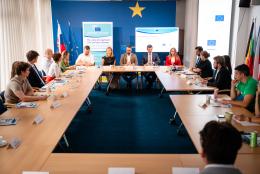
Introduced by the European Economic and Social Committee (EESC) in 2024, the Youth Test is now being recognised as a pioneering method for integrating youth voices into policy-making. A recent roundtable in Bratislava brought together young leaders, policymakers and civil society to examine how the Youth Test can be meaningfully integrated into national decision-making processes.
At its July 2025 plenary session, the European Economic and Social Committee (EESC) adopted a landmark opinion calling for a comprehensive EU strategy to support, protect and empower civil society. The opinion, requested by the European Commission, outlines a blueprint for a more structured, inclusive and resilient civil dialogue framework across the EU.
At its July 2025 plenary session, the European Economic and Social Committee (EESC) adopted an opinion on the European Commission’s “Union of Skills” initiative, calling for a bold, inclusive and well-funded strategy to equip Europe’s workforce with the skills needed for the green and digital transitions, global competitiveness, and social cohesion.
At its July 2025 plenary session, the European Economic and Social Committee (EESC) adopted an own-initiative opinion calling for urgent action to address growing inequalities in access to healthcare across the EU. The opinion highlights how inflation, poverty, and systemic barriers are deepening health disparities, and urges both Member States and the European Commission to act decisively.
At its July 2025 plenary session, the European Economic and Social Committee (EESC) adopted a pivotal opinion calling for the creation of a robust, rights-based EU Anti-Poverty Strategy (APS). This strategy, requested by the European Commission, aims to eradicate extreme poverty across the Union by recognising it not as an unfortunate by-product of economic systems, but as a systemic injustice and a violation of fundamental rights.