The EESC takes note of the Fourth Report on the State of the Energy Union (SEU), supports the objectives of the Energy Union and welcomes the emphasis on the engagement and mobilisation of EU society to take full ownership of the Energy Union.
Download — EESK atzinums: Report on the State of the Energy Union
Liberal democracy relies on civil liberties and a pluralistic civil society, but considerable political forces in today's Europe are challenging liberal democracy. The social, political and legal framework must allow for a pluralistic civil society. Strong social partners and civil society are needed to defend EU values. The EESC calls for the creation of a Democracy Semester, a European control mechanism, corrective economic measures for non-respect of fundamental EU values, the creation of a European statute for CSOs, or interinstitutional CSO authorisation and, tax incentives to support civil society. Burning social questions must be tackled, ensuring social sustainability and inclusive education.
Download — EESK atzinums: Resilient Democracy through a strong and diverse civil society (own-initiative opinion)
The biggest challenge now facing Europe's economy is how to sustain the recovery that is now underway. This is the main message of the 2014 Annual Growth Survey (AGS). Its adoption kicks off the fourth European Semester of economic policy coordination in an environment where growth is beginning to return and Member States are making progress on correcting the imbalances that developed before the crisis.
The 2013 Annual Growth Survey (AGS), which launches the European semester, sets out what the Commission believes should be the overall budgetary, economic and social priorities for the this year. Given the importance of the involvement of the organised civil society and the social partners in setting priorities for action at the national and EU level, the EESC issues its opinion as a contribution to the debates ahead of the Spring European Council.
Download — EUR/005 - EESC opinion on the Annual Growth Survey 2013
Following the third edition of Civil Society Week, the EU’s largest annual gathering of civil society representatives, the EESC reviewed its key outcomes in a plenary debate with EU institutions and stakeholders. With democratic values under growing pressure globally and across parts of the EU, civic participation is more important than ever.
The European institutions should jointly develop unified guidelines for civil dialogue. An interinstitutional agreement could help, for example by assigning different roles and objectives to the different institutions based on their competences. The European institutions must also address capacity issues that hinder civil society organisations and institutions from engaging in dialogue.
In a debate with the Commissioner for Democracy, Michael McGrath, the EESC warned about ongoing efforts to silence, discredit and weaken those who stand up for democracy, social justice and fundamental rights, and expressed its readiness to join forces with the Commission to protect Europe’s civil society and fight polarisation
The European Economic and Social Committee (EESC) must be involved from the outset in the European Commission’s initiatives to step up engagement with civil society. The EESC’s upcoming study on Mapping civil dialogue practises in the EUinstitutions and its 2025 Civil Society Week (17-20 March) can provide valuable input, according to the EESC’s Civil Society Organisations’ Group.
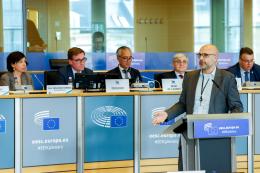
Conference on 'Turn up the volume for civil society! Key actions for the EU's new political cycle' organised by the European Economic and Social Committee's Civil Society Organisations' Group on 3 March in Brussels.
The European Commission’s Defence of Democracy package was the subject of a debate at the April EESC plenary session. Members of the EESC have expressed reservations about its timing and approach, particularly for addressing foreign influence. The EESC argued that the package is not only ineffective, but could harm civic spaces in Europe.