
European Economic
and Social Committee
Inaugural speech by Séamus Boland on key actions for the EU's new political cycle
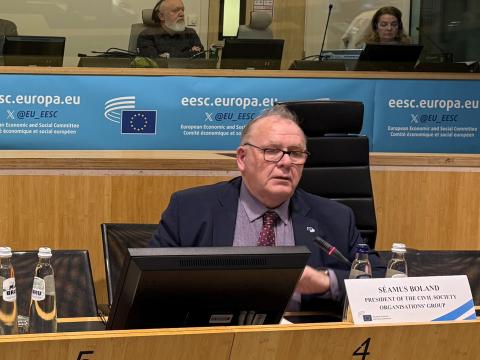
Conference on 'Turn up the volume for civil society! Key actions for the EU's new political cycle' organised by the European Economic and Social Committee's Civil Society Organisations' Group on 3 March in Brussels.
Ladies and gentlemen, dear colleagues,
It is with great pleasure that I would like to welcome you to this conference entitled Turn up the volume for civil society! Key actions for the EU's new political cycle. Let me start by welcoming Mr Julien Mousnier, joining us for the opening of this conference. Mr Mousnier is Director for Rule of Law, Fundamental Rights and Democracy at the Directorate-General for Justice and Consumers (DG JUST) in the European Commission.
Why do we believe it is time to turn up the volume for civil society? Over the last years, civil society actors have intensively promoted civil dialogue. As representatives of citizens who come together to promote a common cause, civil society organisations (CSOs) have a role to play in ensuring that policymaking is informed and responsive to people's needs. This is why we have called for structured, regular, transparent and inclusive civil dialogue. 'Transparency' is the key word here. And as many of you will be aware, the issue of EU financing of CSOs has recently been very much in the news, but for the wrong reasons! Misinformation, disinformation and discreditation of CSOs and the vital work they carry out must not and will not be tolerated! I would like to state this very clearly at the beginning of our event: the EU needs a strong and vibrant civil society and we must work together to push back against such politically motivated accusations!
When it comes to recognising the essential role played by civil society organisations, headway was made with the Conference on the Future of Europe. In our Group, we have worked hard to sustain this momentum and realise our vision of structured, regular, transparent and inclusive civil dialogue. Firstly, we worked on an EESC opinion on Strengthening civil dialogue and participatory democracy in the EU, the first opinion fully dedicated to civil dialogue and participatory democracy in many years! We will hear later from my colleague Pietro Vittorio Barbieri, rapporteur for this opinion. Secondly, in an Open letter together with Civil Society Europe, we collected 156 signatories from 26 Member States calling on the EU institutions to take concrete measures to strengthen civil dialogue. Many of you here today supported our campaign. In addition, we asked the EESC to commission a study on Mapping civil dialogue practices in the EU institutions, which will allow us to know which forms of dialogue are already in place, what works and what should be improved. So we are already laying the groundwork.
At EU level, I was pleased to see that this impulse is maintained, with the announcement of an EU Strategy to support, protect and empower the civil society. Likewise, it is with interest that that I note the recent commitment to stepping up engagement with civil society, to be facilitated by Commissioner Micheal McGrath. We will certainly learn more about those ambitions today.
Now, at the start of the EU's legislative term 2024-2029, let us draw on this strong track record and keep the political momentum alive.
We are at the beginning of a new journey. And I firmly believe that the EESC, with its experience and the platform it provides, must be involved from the outset in the European Commission's initiatives to step up engagement with civil society. The EESC must take part in the governance and be a key part of the initiative on the creation of a Civil Society Platform.
If we are to build structured, regular, transparent and inclusive civil dialogue, then we need to come together and build on what already exists. Consequently, we call for the creation of a working group on civil dialogue, facilitated by the EESC. This working group could create the blueprint for a more enabling environment for CSOs in the policy-shaping process. It would also bring together all relevant stakeholders, including EU institutions and could draw on our study of existing dialogue practices.
Dear ladies and gentlemen, at the start of this new journey, let us stand at the helm, ready to think ahead and advise. Let us raise the volume and ensure that our calls are turned into concrete action!
This brings me to today's agenda.
Firstly, as a Group, we have highlighted that independent civil society organisations help maintain a culture based on fundamental rights and democracy. Yet, the financial health of civil society organisations is a precondition for their impact. It is a precondition for dialogue.
According to a consultation carried out by the EU's Fundamental Rights Agency, 67 % of national and local organisations in 2022 reported difficulties in finding funding relevant to their work and 42% reported difficulties in applying for funding[1]. As noted by the 2024 rule of law report, civil society organisations and human rights defenders have increasingly faced challenges, with new legal restrictions, lack of funding or physical and verbal attacks. In times of shrinking civic space, how can civil society organisations ensure their financial stability and independence?
Today, we will delve deeper into this topic with our esteemed speakers Guiseppe Guerini, Isabel Peñalosa, Brikena Xhomaqi, as well as Ariane Rodert, as moderator. You are all very welcome. It is an issue that, I am sure, touches each and every one of you in this room. I encourage you to share your experiences.
Secondly, I alluded before to the key role of civil society organisations in making sure that polies are targeted to people's needs. One message is clear: If we want to harness this potential, then we must do more to involve civil society organisations as part of a structured civil dialogue. I am therefore very pleased that Berta Mizsei, from the Centre for European Policy Studies (CEPS), is with us today to present the intermediate results of the ongoing research on Mapping civil dialogue practices in the EU institutions.
Ladies and gentlemen, during the last years, we have promoted our vision for civil society. Now the time has come to turn this vision into a reality! Let us turn up the volume for civil society!
Dear Mr Mousnier, we are honoured to have you with us today and to be able to learn more about the European Commissions' the ambitions to step up engagement with civil society.
Thank you for your attention. The floor is yours.
[1] FRA, Protecting civil society – 2023 Update, https://fra.europa.eu/en/publication/2023/civic-space-2023-update?page=5#read-online
Work organisation
Downloads
-
Inaugural speech by Séamus Boland - 3 March 2025