urges the European Commission to approach the UK Government about the possibility of negotiating an ambitious reciprocal youth mobility partnership, that should set out conditions for research, study, training and youth exchange;
strongly supports the creation of a structured engagement between the EU, UK-level authorities and the devolved nations, with robust involvement of youth, including youth work and non-formal learning, to strengthen youth civil society dialogue and cooperation;
strongly recommends that structured inclusion of youth in existing engagement structures be established on both sides;
calls for the establishment of a centralised and accessible information hub for young entrepreneurs, who continue to be impacted by Brexit, experiencing uncertainty around the market access, notably by the stringent new rules governing the movement of goods and services across the Channel.
Lessons learned from the first years of the implementation of the programming period 2021-2027
Event type
Debate
Location
Online event
Belgium
Public debate on 9th Cohesion report: Lessons learned from the first years of the implementation of the programming period 2021-2027, in the framework of the ECO section meeting.
Stand up for democracy & speak up for Europe: Youth priorities for the next EU legislative term
Location
EESC | Brussels
Belgium
Your Europe, Your Say! (YEYS) will take place on Wednesday 6 March 2024 as part of the EESC's Civil Society Week. With the 2024 edition of YEYS taking place in the run up to the European elections, the one day event will seek to inspire its young participants to exercise their democratic right to vote and actively encourage others to do so too.
The EESC underlines that youth participation mechanisms need to be transparent and that the interests and concerns of young people need to be considered at each stage of the policy-making cycle. It proposes that guidelines are set up to support the monitoring and dissemination of the EUYD (EU Youth Dialogue) outcomes and impact and that an online repository be set up where collected documents would be made available. It calls on the Commission and the Member States to support long-term, sustainable and well-functioning management of the EUYD, including the establishment of institutional memory and capacity building processes.
The need for open and transparent budgetary processes has never been more critical. The multiannual financial framework (MFF) emerges as a crucial tool for aligning financial resources with the Union's long-term priorities. The EESC has highlighted significant gaps in the current MFF, including its limited scope in addressing contemporary challenges such as Europe's aging population and strained budgets due to inflation.
The EESC therefore explores a paradigm shift towards Open budgets in the EU –a framework that encompasses not only participatory budgeting but a broader spectrum of fiscal transparency and citizen engagement across all stages of the budget cycle. This approach is aimed at enhancing the responsiveness and effectiveness of EU budget allocations, thereby fostering a more resilient, inclusive, and democratic European economy.
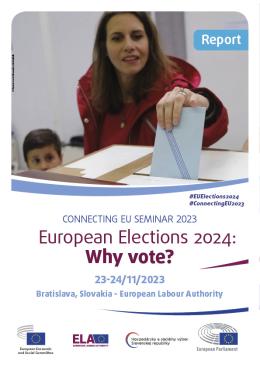
This brochure brings you the highlights of the EESC's Connecting EU 2023 seminar, held in Bratislava in November 2023 under the title "European Elections 2024: Why vote?"
According to Article 175 of the TFEU the Commission shall submit a report to the European Parliament, the Council, the Economic and Social Committee and the Committee of the Regions, every three years, on the progress towards achieving economic, social and territorial cohesion.
The 9th report which covers the first period (2021-2023) of the programming period 2021-2027 will include a record of progress made towards achieving economic, social and territorial cohesion, including the socio-economic situation of regions as well as the integration of EU priorities. It will also include, where appropriate, an indication of future EU measures and policies necessary to strengthen cohesion, as well as to deliver EU priorities.