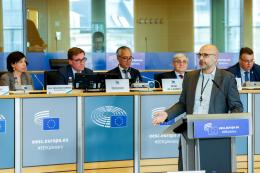
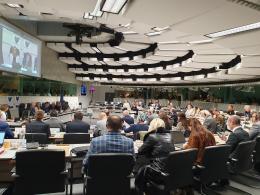
The European Commission’s Defence of Democracy package was the subject of a debate at the April EESC plenary session. Members of the EESC have expressed reservations about its timing and approach, particularly for addressing foreign influence. The EESC argued that the package is not only ineffective, but could harm civic spaces in Europe.
while supporting the goal of transparent lobbying, strongly disagrees with the proposed focus. It urges a EU-wide approach that minimises burdens, safeguards civil society and strengthens existing measures for all lobbying activities.
calls for harmonising electoral processes across Member States to ensure inclusivity, accessibility for people with disabilities, better inclusion of young voters and resilience against potential manipulation;
emphasises the importance of bolstering citizen engagement through innovative formats. It advocates reforms to the European Citizens’ Initiative (ECI) and proposes establishing an EU-wide framework for effective participation.
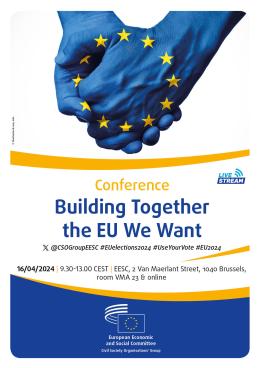
Addressing immediate and long-term challenges, properly implementing existing EU policies and strengthening EU values are some of the priorities proposed by civil society organisations for the new mandate, along with structured civil dialogue and a strong social agenda.
A properly structured civil dialogue can be a means of making European democracies more resilient to current societal challenges. Civil society organisations (CSOs) trust in the European Parliament to be the driving force when it comes to an agreement on structured civil dialogue between the Council of the European Union, the European Commission and the European Parliament, as a Parliament resolution proposed such an agreement in 2022. CSOs consider such an inter-institutional agreement a basis for developing more inclusive and qualitative policy-making.
The written conclusions and recommendations of the conference will feed into an EESC resolution with policy recommendations to the new European Parliament and European Commission, to be adopted in July.
calls for a strategy for civil dialogue, resulting in an action plan, and potentially an interinstitutional agreement among EU institutions for improved civil dialogue facilitated by the EESC;
advocates for making Article 11 TEU effective by strengthening actors in the different EU institutions dealing with civil dialogue and create an annual civil dialogue scoreboard tracing the EU's engagement with civil society, and an accreditation mechanism for CSOs;
reiterates that the EESC should be at the centre of civil society consultation and civil dialogue in general and calls for a stronger role for the Committee in participatory democracy, including being a potential hub for citizen panels.
In a debate with Commission Vice-President and Commissioner for Democracy and Demography Dubravka Šuica, the EESC called for a strategy on civil dialogue as a first step towards strengthening the role of civil society and increasing citizen participation in EU policy-making