
European Economic
and Social Committee
Europe stands to gain from the sound funding of #NextGenerationEU
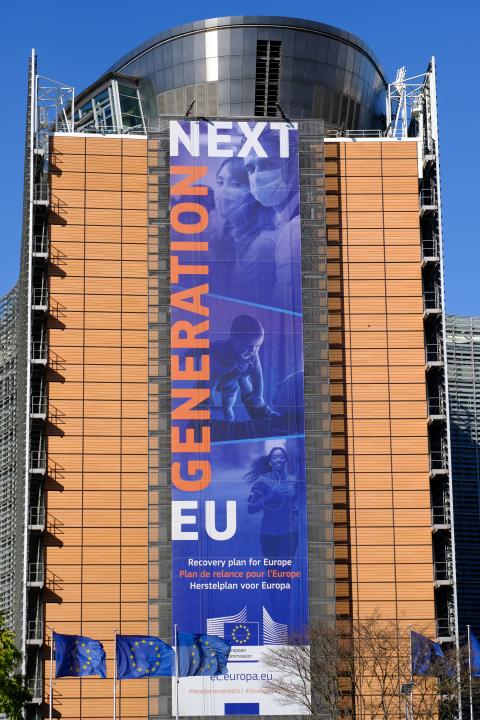
The European Economic and Social Committee (EESC) says that effective funding and solid risk management are essential when raising funds on capital markets, highlighting that the Commission has to manage the borrowing strategy directly and recommending an advisory board where civil society organisations are also represented.
A well-functioning funding strategy is key when raising the money for the European Union's recovery on international capital markets. In its opinion, drawn up by Judith Vorbach and adopted at the July plenary session, the Committee stresses that the smooth implementation of NextGenerationEU (NGEU) requires sound and sustainable funding, along with solid risk management and low borrowing costs.
Speaking during the debate, Ms Vorbach said: borrowing under NextGenerationEU has to be done with democratic control, legitimacy and transparency. An effective funding strategy made up of stable and sustainable funding, solid risk management as well as high creditworthiness and low borrowing costs is in the very interest of the public and especially in the interest of civil society, which ultimately bears the market risks
.
Managing the funding strategy directly
According to the EESC, the European Commission's choice to strengthen its own competences and human resources in order to deal with the funding of NextGenerationEU comes as good news. On the one hand, this entails high funding needs and complex disbursement schedules. On the other, complex financial market developments have to be anticipated in order to borrow under favourable market conditions. That requires market proficiency and experience.
Given the strong public interest in sound funding, it is important that the strategy is managed directly by the Commission and is not outsourced. The EESC calls for a gender balance when appointing staff to the task.
The EESC also calls for the establishment of an advisory board, on which the Commission, the European Parliament, the Council, social partners and organised civil society are represented.
Monitoring on a regular basis
The European Commission can now start borrowing resources for the recovery instrument, following the ratification by all EU Member States of the new Own Resources Decision (ORD), which entered into force on 1 June 2021.
The massive operation on the capital markets will be accompanied by a broad set of risks. For this reason, it is also key that solid risk management systems are established from the beginning, together with a "NGEU account" with the European Central Bank. In this respect, the Committee points out that, as sound risk management is in the public interest, the Chief Risk Officer (CRO) should consult the European Parliament and the Council when drawing up the High-Level Risk and Compliance Policy.
In the EESC's view, the watchwords of the NextGenerationEU borrowing process should always be accountability, transparency and sound financial management. With this in mind, the Committee warns against excessive borrowing from investors outside the EU and advocates the introduction of new own resources for the EU budget.
Finally, taking into account the expectations of civil society organisations, the EESC underlines that the planned "NGEU green bonds", entailing a commitment by EU Member States to use NGEU resources to address climate change, are welcome. Likewise, the Committee proposes issuing "NGEU social bonds", where EU countries would receive financial support to develop projects for inclusive growth and social cohesion.
Background
NextGenerationEU will inject money into the EU economy in the form of grants and loans and will be funded by borrowing of around EUR 800 billion on the capital markets. Although the Commission has borrowed in the past, the volumes, frequency and complexity of this new instrument called for a radical change in the approach to capital markets, based on a diversified funding strategy with a robust governance framework. This new diversified funding strategy combines different funding instruments and techniques with open and transparent communication to market participants.
The borrowing is designed to be temporary and will take place between mid-2021 and 2026. Within this period, the Commission will carry out financing operations of between EUR 150 and 200 billion per year. The financing raised by the EU is supposed to be repaid by December 2058 at the latest, either directly by Member States (for loans) or through the EU budget (for non-repayable support).
The arrangements for overseeing the borrowing are laid out in the "Communication on a new funding strategy to finance NextGenerationEU" of April 2021, which requires the Commission to regularly inform the European Parliament and the Council about its debt management strategy.
Work organisation
Recommended for you
Decision repealing Directive 89/629/EEC
Opinion
DOKUMENTO ESMĖ EESRK: remdamasis tuo, kad pasiūlymas yra visiškai priimtinas ir kad dėl jo neturi pastabų, nusprendė pateikti palankią nuomonę dėl siūlomo dokumento.
EESRK: ES turi atkreipti dėmesį į socialinį tvarumą
News
Europos ekonomikos ir socialinių reikalų komitetas (EESRK) paragino Europos Komisiją paskelbti ilgai lauktą ataskaitą, kurioje būtų įvertinta galimybė išplėsti ES tvarumo taksonomijos reglamento…
RePowerEU Plan
Opinion
DOKUMENTO ESMĖ EESRK mano, kad Europos Komisijos planas „REPowerEU“ yra žingsnis teisinga linkme siekiant, kad ES taptų nepriklausoma nuo Rusijos dujų ir naftos tiekimo; pabrėžia, kad daugelio…
Migrantų instrumentalizavimas ir Ukrainos pabėgėlių krizė verčia persvarstyti migracijos politiką
News
Dėl valstybės remiamo migrantų instrumentalizavimo, kuriuo siekiama destabilizuoti ES, ir dabartinio karo Ukrainoje, sukėlusio precedento neturintį pabėgėlių antplūdį, reikia peržiūrėti Europos…
Individual and collective energy self-consumption as a factor in the fight for the green and energy transition, and for economic and social balance
Opinion
Individualus ir kolektyvinis pasigamintos energijos vartojimas kaip žaliosios ir energetikos pertvarkos ir ekonominės ir socialinės pusiausvyros veiksnys Dokumento esmė EESRK mano, kad vietos ir…