
European Economic
and Social Committee
European Migration Forum showcases how civil society can help implement the Pact on Migration and Asylum
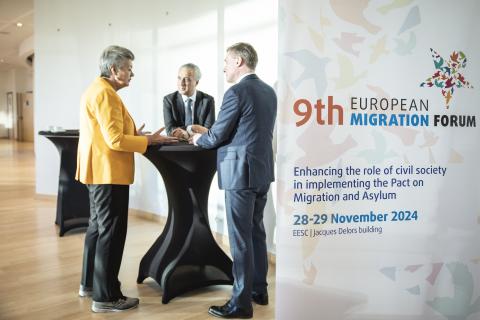
The 9th European Migration Forum, organised by the European Economic and Social Committee (EESC) and the European Commission’s Directorate-General for Migration and Home Affairs, focuses on how civil society can play a key role in the forthcoming implementation of the Pact on Migration and Asylum, while highlighting the direct work of civil society organisations on the ground.
A key focus of the event is the Pact on Migration and Asylum, which entered into force in June, with participants exploring its forthcoming implementation and how civil society can help support and apply the pact humanely. Other topics covered throughout the event include: the new permanent solidarity mechanism; creating closer links between asylum and return procedures; adequate reception conditions; and the Action Plan on Integration and Inclusion 2021-2027.
The Forum brings together representatives from over 100 civil society organisations, local and regional authorities, policy-makers from the Member States, and participants from the Commission and EU agencies, including the European Agency for Fundamental Rights and the European Union Agency for Asylum. Over the years, the format of the European Migration Forum has evolved, placing greater emphasis on participation by attendees, with this 9th edition showcasing testimonies and directly highlighting the work of civil society actors, including refugees and those directly involved in dealing with asylum and migration issues.
Kicking off the opening session, the European Commissioner for Home Affairs, Ylva Johansson, said: ‘I am glad that one of my last public duties as Commissioner will be to speak at the European Migration Forum, a vital platform for civil society organisations, EU Member States and policy-makers to address challenges and opportunities related to migration management. Our discussions over the years always have been inspiring. Together, we can build stronger, more resilient communities, upholding our values, and ensuring that Europe remains a place of refuge and opportunity.’
The EESC President, Oliver Röpke, thanked Commissioner Johansson for her dedication to reforming EU migration policy and highlighted the fact that this Forum marked her last public engagement before stepping down. Addressing the many participants directly, he explained: ‘We must ensure that the migration pact is implemented in the most humane and sustainable way possible and the only way we can do this is by listening to civil society organisations on the ground. Although the pact is adopted, the work is far from over – in fact, one could say the real work starts now.’
The EESC has already adopted key opinions on major themes relating to migration and asylum, including on the setup of the Pact on migration and asylum, on asylum and migration regulation, on the Security Union package/Schengen package, and on the Action plan on integration and inclusion 2021-2027, among others. The EESC also set up a Permanent group on immigration and integration in 2009, which helps give tangible form to the EESC’s role as a facilitator between civil society and the EU institutions on migration issues, while striving to promote the development of a common European immigration and integration policy.
Work organisation
Recommended for you
Decision repealing Directive 89/629/EEC
Opinion
DOKUMENTO ESMĖ EESRK: remdamasis tuo, kad pasiūlymas yra visiškai priimtinas ir kad dėl jo neturi pastabų, nusprendė pateikti palankią nuomonę dėl siūlomo dokumento.
EESRK: ES turi atkreipti dėmesį į socialinį tvarumą
News
Europos ekonomikos ir socialinių reikalų komitetas (EESRK) paragino Europos Komisiją paskelbti ilgai lauktą ataskaitą, kurioje būtų įvertinta galimybė išplėsti ES tvarumo taksonomijos reglamento…
RePowerEU Plan
Opinion
DOKUMENTO ESMĖ EESRK mano, kad Europos Komisijos planas „REPowerEU“ yra žingsnis teisinga linkme siekiant, kad ES taptų nepriklausoma nuo Rusijos dujų ir naftos tiekimo; pabrėžia, kad daugelio…
Migrantų instrumentalizavimas ir Ukrainos pabėgėlių krizė verčia persvarstyti migracijos politiką
News
Dėl valstybės remiamo migrantų instrumentalizavimo, kuriuo siekiama destabilizuoti ES, ir dabartinio karo Ukrainoje, sukėlusio precedento neturintį pabėgėlių antplūdį, reikia peržiūrėti Europos…
Individual and collective energy self-consumption as a factor in the fight for the green and energy transition, and for economic and social balance
Opinion
Individualus ir kolektyvinis pasigamintos energijos vartojimas kaip žaliosios ir energetikos pertvarkos ir ekonominės ir socialinės pusiausvyros veiksnys Dokumento esmė EESRK mano, kad vietos ir…