In this opinion, the EESC fully supports the priorities identified by the Commission and reiterates the need for a cohesive European response. The EESC also stresses that removing barriers is key and that regulatory simplification must take place with full respect for social and workers’ rights. Finally, it calls on the Commission to put forward legislative proposals to address regional supply constraints.
In view of Europe's current security challenges, in particular with the armed conflict caused by Russia’s full-scale aggression against Ukraine, defence funding places a significant burden on the budgets of many EU Member States, worsening their fiscal position.
At the same time, the resources that Member States are currently able to allocate to the development of defence capabilities still seem to be insufficient.
As Europe needs to develop defence capabilities in a more integrated way, there is a need to significantly increase investment in European defence infrastructure and technological innovation to improve preparedness to respond to threats.
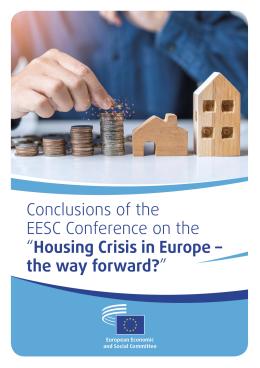
On 20 February 2024 in Brussels, the EESC organised a conference on the Housing Crisis in Europe. This publication sets out the participants' assessment of the current state of affairs and their recommendations on how to tackle the current housing crisis.
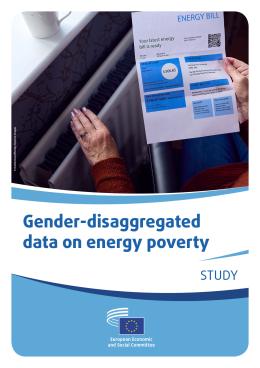
Recent economic shocks from the COVID-19 pandemic and the energy crisis in Europe following Russia’s invasion of Ukraine have brought energy poverty to the forefront of social and political debate. While EU policies increasingly address energy poverty, gender considerations remain overlooked. This study addresses this gap and aims to increase the understanding of the gender-energy poverty nexus, analysing existing literature and EU and national policies.
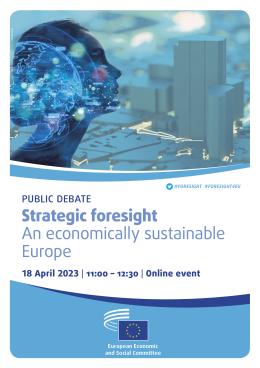
With this debate, the ECO section is providing ex-ante input to the European Commission, in preparation for the upcoming 2023 strategic foresight cycle that wants to shed light on the strategic decisions needed to ensure a socially and economically sustainable Europe with a stronger role in the world in the coming decades.
Corruption and the lack of rule of law undermine the mutual trust that is underpinning the internal market. The EESC believes that efforts to fight corruption should be better aligned with efforts to safeguard and develop democracy in the EU. Moreover, the EESC stresses that the EU must prioritise evaluating the legislative framework on the integrity of public procurement and its implementation in practice and believes that the cross-debarment system could be useful for protecting the internal market from misuse of public resources allocated to tenders.
Download — Tuairim ó CESE: Corruption in public procurement and its impact on the internal market
Activities of organised crime organisations like money laundering and the tapping of public funds have consequences for the economy, business and society. A crisis like the Covid-19 pandemic may be an opportunity for organised crime to spread their activity, gain power and even innovate to find new ways to pursue their objectives.
The proposal on an International Procurement Instrument (IPI) is the EU response to the lack of a level playing field in world procurement markets. While our public procurement market is open to foreign bidders, the procurement markets for foreign goods and services in third countries remain to a large extent closed de iure or de facto. The IPI aims at encouraging partners to engage in negotiations and opening participation for EU bidders and goods in third countries' tenders. A first proposal on this issue was made in 2012 (COM(2012) 124 final) but there was no agreement in the Council. The new Commission proposal incorporates some of the changes requested from the European Parliament and tries to reply to some of the concerns expressed in the Council. A number of Member States have expressed reservations as regards the principle of closing the EU market for goods and services originating in certain third countries, even if only temporarily and in a targeted way.
Download — Tuairim ó CESE: Access of third country goods and services to the European Union's internal market in public procurement
The Communication presents a public procurement strategy which sets out the overall policy framework and defines clear priorities to improve procurement in practice and support investment within the EU. Three concrete initiatives are presented alongside this strategy. The Commission presents a Communication on a mechanism for large infrastructure projects to provide clarity and guidance to public authorities on public procurement. It also proposes a Recommendation to professionalise public buyers because a skilful workforce is essential for effective implementation. In parallel, a targeted consultation is launched on a draft guidance on public procurement of innovation, to support the breakthrough of new and more sustainable solutions for our societies.
Download — Tuairim ó CESE: Public procurement package