
European Economic
and Social Committee
What competitiveness will look like in the new European growth model
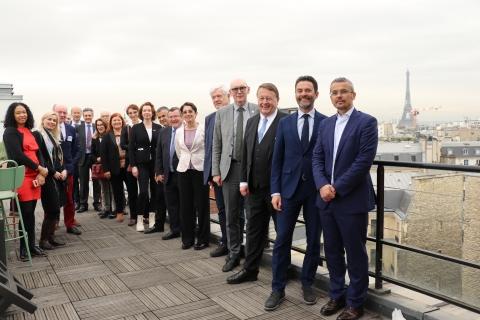
Emmanuel Macron launched the French presidency of the Council of the EU by proposing the idea of a new European growth model. This new model should make it possible to create employment, reconcile economic development and climate ambition, respond to digital challenges and rely on a redesigned European financial framework.
But how can we achieve a Europe that can reconcile the paradox between growth and prosperity on the one hand and a sustainable future for our planet on the other? How can we guarantee the competitiveness of our companies in this just transition?
To answer these questions, the EESC Employers' Group met with high-level speakers from business, academia and other EU institutions on 15 March.
In his introductory remarks, Stefano Mallia pointed out that when the event was planned, it was envisaged in a different context. Priorities had shifted since the start of Russia's war in Ukraine, with security, energy and migration now top of the agenda. This could also be seen at the European Council summit in Versailles, which was originally scheduled to discuss the new European growth model, but re-focused its agenda to adopt a declaration on the Russian aggression against Ukraine.
However, European prosperity is the best demonstration that our values are not only right, but also make our society healthy and resilient, which made the discussion even more timely.
Panel 1: Internal dimension of EU competitiveness: unlocking the full potential of the Single Market
Europe's competitiveness starts at home. To give its companies, and especially SMEs, the chance to thrive, it has to work towards removing all barriers that limit the power of its Single Market. Europe has to offer a competitive business framework that attracts skills and investment, allows for innovation and protects its SMEs.
There is no doubt that for Europe to stay competitive it needs to successfully manage the Twin Transitions – and a key factor here Emmanuel Macron launched the French presidency of the Council of the EU by proposing the idea of a new European growth model. This new model should make it possible to create employment, reconcile economic development and climate ambition, respond to digital challenges and rely on a redesigned European financial framework. will be investment. As keynote speaker Sandrine Gaudin, the French government's Secretary-General for European Affairs, and European Adviser to the French Prime Minister, stated: "We have a colossal need for investment – and we need a budgetary framework that allows us to reduce debt but also to ensure these investments, especially in innovative technologies, and also to close the gap with the United States."
The competitiveness of the Single Market should always be on legislators' minds. Therefore, a competitiveness check should be introduced for all EU initiatives, as a control measure to avoid proposals that hinder increased competitiveness, more jobs and sustainable growth.
What came out of the discussion is that Europe needs to facilitate "doing business" more, for example by simplifying market entrance and ensuring easier access to finance.
Panel 2: External dimension of EU competitiveness: Asserting Europe's place in the world
Strategic autonomy has become a key priority in the last few years. The COVID-19 crisis made Europe painfully aware of its dependency on other markets – an unpleasant truth that gained further impetus after the start of Russia's war in Ukraine – and strengthened the realisation that dependencies e.g. on raw materials, energy and agri-food must be minimised and diversified.
However, this is by no means a call to build a European fortress. What it means is that rather than being naïve, Europe has to create an offensive trade structure that limits its dependency on single players as far as possible, while further continuing to nurture relations with its external partners.
In the end, Europe has a lot to offer – we need to realise our strengths and build on them.
As EESC President Christa Schweng stated in the meeting: "Our businesses and especially our SMEs are the locomotive pulling European society towards a more economically prosperous, socially inclusive and environmentally sustainable future." The meeting clearly showed that any new European growth model needs to keep the competitiveness of its enterprises as its main focal point.
Work organisation
Recommended for you
Toghadh Séamus Boland ina Uachtarán ar Choiste Eacnamaíoch agus Sóisialta na hEorpa, agus gheall sé go gcuirfear an tsochaí shibhialta i gcroílár na hEorpa
News
Toghadh Séamus Boland na hÉireann ar an 35ú Uachtarán ar Choiste Eacnamaíoch agus Sóisialta na hEorpa (CESE) le haghaidh an téarma oifige 2025-2028. Is urlabhra riamh anall é do phobail na tuaithe…
CESE, Uachtarántacht na hÉireann agus an fhís choiteann atá acu
News
I ndiaidh na díospóireachta a reáchtáladh le Comhaltaí CESE le linn sheisiún iomlánach mhí Iúil, níl aon dabht faoi ach go bhfuil clár Uachtaránacht reatha an Aontais ag freagairt go mór do na…
#YEYS2022: Ceist na bréagaisnéise pléite ag aos óg na hEorpa agus a dtuairimí ina leith curtha in iúl acu don Leas-Uachtarán Jourová
News
Chuir daltaí meánscoile ó gach cearn den Eoraip ocht gcinn de thograí nithiúla faoi bhráid Leas-Uachtarán an Choimisiúin Eorpaigh um Luachanna agus um Thrédhearcacht, Věra Jourová. Bhí páirt á…
#CivilsocietyforUkraine
News
Cáineann CESE ionradh Rialtas na Rúise ar an Úcráin, ionradh atá gan údar agus gan chúis Rún ó Choiste Eacnamaíoch agus Sóisialta na hEorpa (CESE) maidir leis an gcogadh san Úcráin agus an tionchar…
Eagrán speisialta de CESE info
News
Eagrán speisialta de CESE info atá dírithe ar an Úcráin. Is féidir scéal Tetyana Ogarkova a léamh, bean a chuala fuaim ionradh na Rúise ar dhúiseacht di an 24 Feabhra.