
European Economic
and Social Committee
European Commission’s Executive Vice-President Henna Virkkunen: ‘Technological sovereignty must put people at its heart’
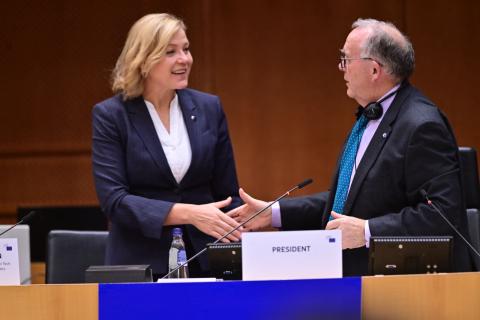
At its October plenary session, the EESC held a debate on Europe’s technological sovereignty which stressed that technological progress must go hand in hand with better jobs and working conditions.
Europe’s reliance on non-European providers raises questions about its industrial competitiveness, economic resilience and control over critical digital infrastructure. With Europe facing growing global competition, geopolitical tensions and pressure on supply chains, the European Economic and Social Committee (EESC) points out that the EU needs to strengthen its capabilities in strategic technologies such as AI, cloud infrastructure and semi-conductors.
In a debate with the Commission’s Executive Vice-President for Technological Sovereignty, Security and Democracy Henna Virkkkunen, held at the October plenary, EESC President Séamus Boland said that ‘technological sovereignty does not mean technological isolation. It means ensuring that Europe has the capacity, resilience and choices needed to protect its values, strengthen its competitiveness and shape its own technological future.’
’Our ambition must go beyond competitiveness and reducing dependencies,’ Mr Boland said. ‘Technological progress must contribute to better jobs and working conditions, while protecting fundamental rights and ensuring that workers and civil society have a meaningful voice in shaping the digital transition. We must have a people centred approach.’
Presenting the European Commission’s point of view, Ms Virkkunen stressed that ‘Technological sovereignty does not mean closing Europe off. It does not mean doing everything alone. It means that Europeans decide for themselves. That our hospitals, our factories, our public administrations and our democracy do not depend on choices made elsewhere. Today, too often, they do.’ In a nutshell, she said that ‘technological sovereignty must put people at its heart.’
On a different note, Cecilia Bonefeld-Dahl, Director-General of DIGITALEUROPE, argued against different national sovereignty frameworks and underscored that 98% of the EU’s companies were SMEs. This means that the EU needs ‘to build fences where there are risks and open market, innovation and building capabilities where that benefits us’. She also advocated for 25% of the next Multiannual Financial Framework to be earmarked for developing Europe’s critical assets.
EU dependencies in figures
The scale of the challenge is significant. According to the European Commission, Europe still relies on non-EU providers for more than 80% of its digital products, services, infrastructure and intellectual property.
AI is one obvious example of this dependency. Recent analysis estimates that only around 5% of global AI capacity is currently located in the EU. In addition, Europe produces less than 10% of the world’s chips and depends on the USA and Asia for the most advanced ones.
Europe’s capacity to act independently depends on its ability to master the technologies on which our economy and society rely. From semiconductors to cloud infrastructure, AI and data, the EU needs to strengthen its capabilities and reduce critical dependencies.
The EESC’s work on EU technological sovereignty
Semiconductors are a strategic asset for Europe’s competitiveness, technological sovereignty, economic security and industrial resilience and the EU should build a European semiconductor system across the full value chain. This is the main recommendation included in the opinion on the Chips Act 2 by rapporteur Gonçalo Lobo Xavier and co-rapporteur Dirk Bergrath, adopted during the plenary.
‘Europe cannot achieve technological sovereignty through legislation and public funding alone. We need competitive companies, private investment and a strong industrial ecosystem. We should not try to copy the United States or Asia, but build on Europe's own strengths — its knowledge, talent and industrial expertise,’ said Mr Lobo Xavier. ‘The real success of Chips Act 2 will be measured not by the ambitions we announce, but by the investments we attract, the businesses we strengthen and the opportunities we create.’
Mr Bergrath focused on investing public money to deliver lasting industrial capacity, good jobs and stronger regions in Europe and added: ‘Competitiveness and quality jobs go hand in hand. Chips Act 2 must help Europe keep and develop its talent, invest in skills across the whole value chain and involve workers and their representatives in shaping the transformation. That is how we turn ambition into real value for our economy and our society.’
In order to deliver a cross-sectoral EU digital sovereignty strategy, the EU and Member States have to invest in ‘Made in the EU’ digital infrastructure and prioritise open-source solutions and European alternatives through ‘EU first’ and ‘comply or explain’ public procurement principles.
In the opinion on Overcoming digital dependencies protects workers’ rights and data – EU sovereignty in the cloud, also adopted during the debate, the rapporteur Thomas Kattnig stressed that ‘digital sovereignty must protect democracy and workers’ rights, ensuring transparency and democratic control over AI and algorithms, meaningful social dialogue, skills development and fair sharing of productivity gains.’
Work organisation
Recommended for you
Toghadh Séamus Boland ina Uachtarán ar Choiste Eacnamaíoch agus Sóisialta na hEorpa, agus gheall sé go gcuirfear an tsochaí shibhialta i gcroílár na hEorpa
News
Toghadh Séamus Boland na hÉireann ar an 35ú Uachtarán ar Choiste Eacnamaíoch agus Sóisialta na hEorpa (CESE) le haghaidh an téarma oifige 2025-2028. Is urlabhra riamh anall é do phobail na tuaithe…
CESE, Uachtarántacht na hÉireann agus an fhís choiteann atá acu
News
I ndiaidh na díospóireachta a reáchtáladh le Comhaltaí CESE le linn sheisiún iomlánach mhí Iúil, níl aon dabht faoi ach go bhfuil clár Uachtaránacht reatha an Aontais ag freagairt go mór do na…
#YEYS2022: Ceist na bréagaisnéise pléite ag aos óg na hEorpa agus a dtuairimí ina leith curtha in iúl acu don Leas-Uachtarán Jourová
News
Chuir daltaí meánscoile ó gach cearn den Eoraip ocht gcinn de thograí nithiúla faoi bhráid Leas-Uachtarán an Choimisiúin Eorpaigh um Luachanna agus um Thrédhearcacht, Věra Jourová. Bhí páirt á…
#CivilsocietyforUkraine
News
Cáineann CESE ionradh Rialtas na Rúise ar an Úcráin, ionradh atá gan údar agus gan chúis Rún ó Choiste Eacnamaíoch agus Sóisialta na hEorpa (CESE) maidir leis an gcogadh san Úcráin agus an tionchar…
Eagrán speisialta de CESE info
News
Eagrán speisialta de CESE info atá dírithe ar an Úcráin. Is féidir scéal Tetyana Ogarkova a léamh, bean a chuala fuaim ionradh na Rúise ar dhúiseacht di an 24 Feabhra.