
European Economic
and Social Committee
EESC calls for backing for farms that create jobs, enable workers to reach their potential and revive rural areas
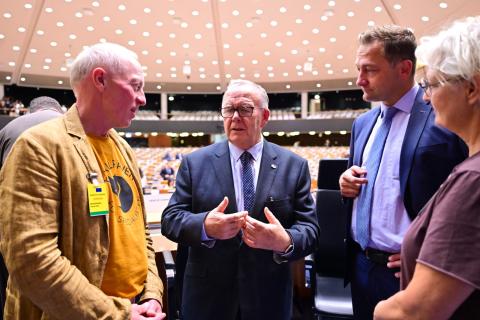
The 2026 EU Organic Awards have once again rewarded outstanding, innovative and sustainable projects across Europe’s organic value chain. The winners offer a tangible example of the social farming model promoted by the European Economic and Social Committee: farms that create jobs, enable workers to reach their potential and help rural communities thrive. In a newly adopted opinion, the EESC urges the European Commission and Member States to give such initiatives long-term support.
The winners of the 2026 EU Organic Awards, Hans Erik Jørgensen and Kirsten Krunderup Rasmussen from Denmark, put this approach into practice on their farm, creating job opportunities for people (including Ukrainian refugees) who face barriers to the labour market. They shared their experience with EESC members during a plenary debate on how organic and social farming can benefit people, nature and rural areas.
In its opinion on Social farming as a tool for innovation in agriculture, the EESC calls for social farming to be recognised as an agricultural innovation that provides responses to local social and health needs. It recommends long-term, cross-sector support rather than isolated short-term projects, as well as easier access to funding and a smaller administrative burden.
Social farms combine agriculture with measures to help people join and blossom in the labour market, education and employment. They can provide therapy, training, jobs and social contact for people who face barriers to work or participation in community life.
‘Social farming brings agriculture, health and personal development together. It offers practical help to people and strengthens rural communities. The EU must replace short-term projects with stable support, simple rules and clear quality standards,’ said Roman Haken, rapporteur for the opinion.
The EESC calls for:
- social farming to be recognised as an agricultural innovation that addresses local social and health needs;
- long-term, cross-sector funding, easier access to support and less red tape;
- an EU framework guaranteeing the origin and quality of social-farming goods and services;
- fair wages, safe working conditions, training and practical impact measurement.
The EESC stresses that social farming can strengthen support infrastructure where rural services are limited. By linking agriculture with health and social work, it can also offer innovative, non-pharmacological approaches to social support.
From the farm to the plenary
The recommendations were discussed during an EESC plenary debate with the Commissioner for Agriculture and Food, Christophe Hansen on how organic and social farming can benefit people, nature and rural areas.
‘Farms do more than produce food. They can protect nature, create opportunities and keep rural communities alive. Organic and social farming show that these goals can go hand in hand,’ said EESC President Séamus Boland.
‘This year’s best organic farmer has built his business around creating employment opportunities for those who need them most. These examples show that economic, social and environmental objectives can reinforce one another rather than compete,’ said Agriculture Commissioner Christophe Hansen.
Under its proposed post-2027 Common Agricultural Policy, the European Commission says the EU budget will continue to support organic farming and innovation while making the sector more competitive and resilient.
From experience on the ground to EU recommendations
Hans Erik Jørgensen and Kirsten Krunderup Rasmussen joined the plenary debate to share the experience behind their award-winning farm. Their work shows how organic farming can deliver combined economic, social and environmental benefits, and how solutions developed on the ground can inform EU policy.
‘This year’s winners show that sustainable farming can also be innovative and commercially successful. They create jobs, strengthen rural communities and turn Europe’s agricultural transition into reality,’ said Stoyan Tchoukanov, President of the EESC’s Section for Agriculture, Rural Development and the Environment.
Background
The EU Organic Awards were launched in 2022 under the EU Action Plan for the Development of Organic Production. They are jointly organised by the European Commission, the European Economic and Social Committee, the European Committee of the Regions, COPA-COGECA and IFOAM Organics Europe. The 2026 awards recognised seven projects across the organic value chain.
Contact: thomas.kersten@eesc.europa.eu / aikaterini.serifi@eesc.europa.eu
Work organisation
Recommended for you
Toghadh Séamus Boland ina Uachtarán ar Choiste Eacnamaíoch agus Sóisialta na hEorpa, agus gheall sé go gcuirfear an tsochaí shibhialta i gcroílár na hEorpa
News
Toghadh Séamus Boland na hÉireann ar an 35ú Uachtarán ar Choiste Eacnamaíoch agus Sóisialta na hEorpa (CESE) le haghaidh an téarma oifige 2025-2028. Is urlabhra riamh anall é do phobail na tuaithe…
CESE, Uachtarántacht na hÉireann agus an fhís choiteann atá acu
News
I ndiaidh na díospóireachta a reáchtáladh le Comhaltaí CESE le linn sheisiún iomlánach mhí Iúil, níl aon dabht faoi ach go bhfuil clár Uachtaránacht reatha an Aontais ag freagairt go mór do na…
#YEYS2022: Ceist na bréagaisnéise pléite ag aos óg na hEorpa agus a dtuairimí ina leith curtha in iúl acu don Leas-Uachtarán Jourová
News
Chuir daltaí meánscoile ó gach cearn den Eoraip ocht gcinn de thograí nithiúla faoi bhráid Leas-Uachtarán an Choimisiúin Eorpaigh um Luachanna agus um Thrédhearcacht, Věra Jourová. Bhí páirt á…
#CivilsocietyforUkraine
News
Cáineann CESE ionradh Rialtas na Rúise ar an Úcráin, ionradh atá gan údar agus gan chúis Rún ó Choiste Eacnamaíoch agus Sóisialta na hEorpa (CESE) maidir leis an gcogadh san Úcráin agus an tionchar…
Eagrán speisialta de CESE info
News
Eagrán speisialta de CESE info atá dírithe ar an Úcráin. Is féidir scéal Tetyana Ogarkova a léamh, bean a chuala fuaim ionradh na Rúise ar dhúiseacht di an 24 Feabhra.