
European Economic
and Social Committee
EESC calls for backing for farms that create jobs, enable workers to reach their potential and revive rural areas
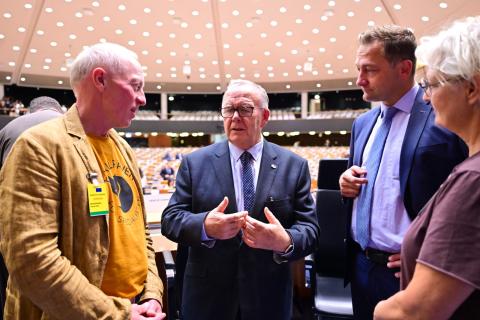
The 2026 EU Organic Awards have once again rewarded outstanding, innovative and sustainable projects across Europe’s organic value chain. The winners offer a tangible example of the social farming model promoted by the European Economic and Social Committee: farms that create jobs, enable workers to reach their potential and help rural communities thrive. In a newly adopted opinion, the EESC urges the European Commission and Member States to give such initiatives long-term support.
The winners of the 2026 EU Organic Awards, Hans Erik Jørgensen and Kirsten Krunderup Rasmussen from Denmark, put this approach into practice on their farm, creating job opportunities for people (including Ukrainian refugees) who face barriers to the labour market. They shared their experience with EESC members during a plenary debate on how organic and social farming can benefit people, nature and rural areas.
In its opinion on Social farming as a tool for innovation in agriculture, the EESC calls for social farming to be recognised as an agricultural innovation that provides responses to local social and health needs. It recommends long-term, cross-sector support rather than isolated short-term projects, as well as easier access to funding and a smaller administrative burden.
Social farms combine agriculture with measures to help people join and blossom in the labour market, education and employment. They can provide therapy, training, jobs and social contact for people who face barriers to work or participation in community life.
‘Social farming brings agriculture, health and personal development together. It offers practical help to people and strengthens rural communities. The EU must replace short-term projects with stable support, simple rules and clear quality standards,’ said Roman Haken, rapporteur for the opinion.
The EESC calls for:
- social farming to be recognised as an agricultural innovation that addresses local social and health needs;
- long-term, cross-sector funding, easier access to support and less red tape;
- an EU framework guaranteeing the origin and quality of social-farming goods and services;
- fair wages, safe working conditions, training and practical impact measurement.
The EESC stresses that social farming can strengthen support infrastructure where rural services are limited. By linking agriculture with health and social work, it can also offer innovative, non-pharmacological approaches to social support.
From the farm to the plenary
The recommendations were discussed during an EESC plenary debate with the Commissioner for Agriculture and Food, Christophe Hansen on how organic and social farming can benefit people, nature and rural areas.
‘Farms do more than produce food. They can protect nature, create opportunities and keep rural communities alive. Organic and social farming show that these goals can go hand in hand,’ said EESC President Séamus Boland.
‘This year’s best organic farmer has built his business around creating employment opportunities for those who need them most. These examples show that economic, social and environmental objectives can reinforce one another rather than compete,’ said Agriculture Commissioner Christophe Hansen.
Under its proposed post-2027 Common Agricultural Policy, the European Commission says the EU budget will continue to support organic farming and innovation while making the sector more competitive and resilient.
From experience on the ground to EU recommendations
Hans Erik Jørgensen and Kirsten Krunderup Rasmussen joined the plenary debate to share the experience behind their award-winning farm. Their work shows how organic farming can deliver combined economic, social and environmental benefits, and how solutions developed on the ground can inform EU policy.
‘This year’s winners show that sustainable farming can also be innovative and commercially successful. They create jobs, strengthen rural communities and turn Europe’s agricultural transition into reality,’ said Stoyan Tchoukanov, President of the EESC’s Section for Agriculture, Rural Development and the Environment.
Background
The EU Organic Awards were launched in 2022 under the EU Action Plan for the Development of Organic Production. They are jointly organised by the European Commission, the European Economic and Social Committee, the European Committee of the Regions, COPA-COGECA and IFOAM Organics Europe. The 2026 awards recognised seven projects across the organic value chain.
Contact: thomas.kersten@eesc.europa.eu / aikaterini.serifi@eesc.europa.eu
Work organisation
Recommended for you
Tetyana Ogarkova: "The day of victory will come but it will not bring normality back"
Agenda
On 24 February 2022, the lives of millions of Ukrainians were turned upside down. Now, when we say the word "victory", we expect that day to be the way things used to be. A normal day, a day of peace…
Lutte contre la précarité énergétique: garantir un approvisionnement énergétique abordable devrait figurer au premier rang des priorités politiques des pays de l’UE
News
Alors que le nombre de ménages qui sont dans l’incapacité de chauffer leur logement va vraisemblablement augmenter dans l’Union, avec une inflation annuelle de l’énergie qui dépasse 40 %, il y a…
Les zones rurales ont le potentiel pour produire davantage de résultats
News
Si l’attrait de la vie à la campagne s’est accru ces toutes dernières années, de nombreuses zones rurales de l’Union restent confrontées à un certain nombre de problèmes qui dissuadent les personnes…
Pour lutter contre le sans-abrisme, il faut une approche globale et une action collective
News
Le 7 octobre dernier, le Comité économique et social européen (CESE) a tenu une conférence sur le sans-abrisme et les moyens d’éradiquer ce phénomène d’ici à 2030, en appliquant le principe du…
Un rôle actif pour la société civile organisée est essentiel à la résilience de l’Union européenne
News
Le CESE a tenu un débat en session plénière sur l’importance croissante de la société civile organisée et des villes pour mettre l’Europe en capacité de faire face aux chocs asymétriques et aux…