
European Economic
and Social Committee
EU Inc.: the first step towards a Europe where companies can scale
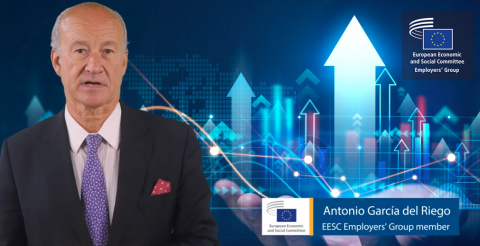
The European Commission's proposal for a European Innovative Company (EU Inc.) is much more than another company law initiative. It is the first concrete legislative proposal implementing the broader vision of the 28th Regime, a concept that has gained considerable momentum following the reports by Enrico Letta and Mario Draghi and is increasingly seen as a key instrument to strengthen Europe's competitiveness.
The philosophy behind the 28th Regime is straightforward. While Europe has built a successful Single Market, companies wishing to operate across borders still face 27 different legal systems, administrative procedures and corporate frameworks. This fragmentation creates unnecessary costs, legal uncertainty and barriers that prevent European businesses from reaching the scale required to compete globally.
The objective of the EU Inc. is not to replace national legal systems, but to complement them by creating optional European legal frameworks that companies can choose when operating across borders. Its purpose is not harmonisation for its own sake, but the gradual removal of internal barriers that continue to fragment the Single Market. EU Inc. is the first practical expression of this approach.
Importantly, the Commission has chosen a pragmatic starting point. The proposal focuses exclusively on company law, establishing an optional European corporate form while leaving taxation, labour law, insolvency law and other areas of national competence untouched. Those matters remain governed by the existing Union and national legal frameworks.
This is a sensible approach. Rather than attempting an ambitious but politically difficult harmonisation across multiple policy areas, the Commission has identified one of the obstacles that businesses consistently highlight: the legal complexity of creating and operating companies across the Single Market. The proposal therefore points in the right direction.
Tackling fragmentation to gain scale
Europe's competitiveness challenge is often framed as a problem of excessive regulation. Regulatory simplification is undoubtedly necessary, but it is only part of the solution. The real obstacle is fragmentation. European companies continue to operate in a market that is economically integrated but legally divided. As a result, many innovative firms struggle to expand beyond their home market, attract sufficient investment or achieve the continental scale increasingly required to compete with global rivals.
The real ambition of EU Inc. is therefore not simply to simplify administrative procedures. It is to enable European companies to gain scale within Europe.
By providing a common company law framework, EU Inc. can reduce legal fragmentation, facilitate cross-border establishment, improve access to finance and allow companies to organise themselves from the outset with a European rather than a purely national perspective.
In this sense, the proposal is particularly relevant for start-ups and scale-ups, which face the greatest barriers to cross-border expansion. However, the ambition should not stop there. If Europe wants to create global champions, the European company form should accompany businesses throughout their growth journey. EU Inc. should not become a temporary legal vehicle that companies are expected to abandon once they become successful. It should evolve into a genuine European company form capable of supporting businesses as they grow, innovate and compete across the Union.
The EESC recommendations
The discussions within the EESC have identified areas where the proposal can be strengthened. Questions relating to legal certainty, workers' participation rights, safeguards against abuse and the scope of the instrument deserve careful consideration. These debates are important because they will determine whether the new framework is both attractive for businesses and respectful of Europe's social and legal traditions. But the broader direction should not be lost.
EU Inc. is the first concrete building block of a wider strategy to deepen the Single Market. It represents a shift in European policymaking, from coordinating 27 national legal systems towards creating optional European frameworks that enable companies to operate seamlessly across the Union.
For the Employers' Group, this is the right direction.
Europe's competitiveness challenge is, above all, a scale challenge. Simplification is necessary, but not enough. European companies need a Single Market that allows them to organise, invest, innovate and expand at continental scale.
If Europe wants its companies to compete globally, it must first enable them to gain scale within Europe. That is precisely the ambition of the 28th Regime concept, and EU Inc. is the first concrete step.
By Antonio García del Riego, EESC Employers' Group member and Co-Rapporteur of Opinion INT/1123 EU Inc. - A single harmonised set of rules for innovative companies throughout the EU.
Work organisation
Recommended for you
Toghadh Séamus Boland ina Uachtarán ar Choiste Eacnamaíoch agus Sóisialta na hEorpa, agus gheall sé go gcuirfear an tsochaí shibhialta i gcroílár na hEorpa
News
Toghadh Séamus Boland na hÉireann ar an 35ú Uachtarán ar Choiste Eacnamaíoch agus Sóisialta na hEorpa (CESE) le haghaidh an téarma oifige 2025-2028. Is urlabhra riamh anall é do phobail na tuaithe…
CESE, Uachtarántacht na hÉireann agus an fhís choiteann atá acu
News
I ndiaidh na díospóireachta a reáchtáladh le Comhaltaí CESE le linn sheisiún iomlánach mhí Iúil, níl aon dabht faoi ach go bhfuil clár Uachtaránacht reatha an Aontais ag freagairt go mór do na…
#YEYS2022: Ceist na bréagaisnéise pléite ag aos óg na hEorpa agus a dtuairimí ina leith curtha in iúl acu don Leas-Uachtarán Jourová
News
Chuir daltaí meánscoile ó gach cearn den Eoraip ocht gcinn de thograí nithiúla faoi bhráid Leas-Uachtarán an Choimisiúin Eorpaigh um Luachanna agus um Thrédhearcacht, Věra Jourová. Bhí páirt á…
#CivilsocietyforUkraine
News
Cáineann CESE ionradh Rialtas na Rúise ar an Úcráin, ionradh atá gan údar agus gan chúis Rún ó Choiste Eacnamaíoch agus Sóisialta na hEorpa (CESE) maidir leis an gcogadh san Úcráin agus an tionchar…
Eagrán speisialta de CESE info
News
Eagrán speisialta de CESE info atá dírithe ar an Úcráin. Is féidir scéal Tetyana Ogarkova a léamh, bean a chuala fuaim ionradh na Rúise ar dhúiseacht di an 24 Feabhra.