
European Economic
and Social Committee
Group debate with partner organisations: Balancing external pressure with internal reform
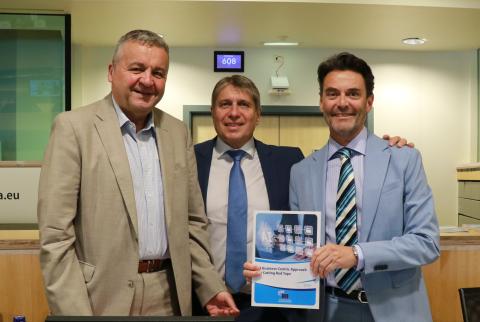
On 18 June 2025, representatives from leading business and SME organisations convened to discuss Europe’s upcoming priorities, focusing on competitiveness, regulatory simplification, and the challenges posed by the current geopolitical climate. The meeting, opened by Stefano Mallia, President of the EESC Employers' Group, brought together key voices including Markus J. Beyrer, Director General of BusinessEurope, and Gerhard Huemer, Director of SMEUnited.
Stefano Mallia set the tone by acknowledging the tense geopolitical environment but cautioned against losing sight of Europe’s internal priorities. “We must not neglect the urgent need to improve competitiveness and reduce red tape,” Mallia stated. He highlighted recent progress on digitalisation, notably the launch of AI-powered tools to cut red tape.
Beyrer echoed the call for simplification, referencing BusinessEurope’s comprehensive 11-chapter proposal to cut regulatory burdens. While he recognised the European Commission’s recent steps, he noted that “many challenges remain unresolved,” expressing disappointment with the Council’s resistance but commending the Parliament’s constructive stance.
Beyrer identified the Omnibus 1 package as the central battleground for regulatory simplification. On energy, he welcomed initial moves to lower costs but urged faster implementation. He also voiced strong support for the 28th regime and mutual recognition of professional qualifications.
On international trade, Beyrer advocated for a balanced approach: “We must maintain strong US ties while avoiding decoupling from China.” He stressed the importance of finalising the Mercosur agreement, warning that reopening negotiations would be “a road to hell.” Beyrer called for diversified trade partnerships as that would reinforce Europe’s credibility as a reliable partner.
Huemer provided a sobering counterpoint, warning that SMEs have yet to see tangible benefits from ongoing talks on competitiveness and simplification. He raised concerns that policies aimed at midcaps could siphon resources from SMEs and questioned the real-world impact of strategies like the single market and investment union, calling many of them “largely theoretical.”
Huemer was sceptical about the 28th regime’s effectiveness and highlighted the practical challenges for scale-ups and start-ups in Europe. He emphasised that the Green Deal must deliver real results, and that supply chain resilience hinges on the successful implementation of Omnibus 1.
On the broader topic of better regulation, Beyrer answered questioned and cautioned against allowing impact assessments to become a "bottleneck that delays crucial legislative packages" such as the Omnibus initiative. He emphasised that while thorough assessments are important, they should not be used as an excuse to stall progress. Furthermore, Beyrer advocated for making better use of existing data to inform policy decisions, ensuring that reforms are both evidence-based and efficiently implemented. Huemer acknowledged incremental improvements in impact assessments but noted that most regulatory burdens are imposed at the national level.
Huemer also flagged cybersecurity and defence preparedness as growing priorities, and cautioned that meaningful progress is unlikely without a sufficiently resourced EU budget.
The discussion underscored the need for Europe to be proactive, not reactive, in addressing both internal and external challenges. While there is consensus on the need for regulatory simplification and enhanced competitiveness, stakeholders emphasised that progress must translate into measurable, real-world benefits—especially for Europe’s SMEs.
As Europe navigates a complex geopolitical landscape, the message is clear: internal reforms and international credibility must go hand in hand, with a renewed focus on delivering tangible outcomes for businesses of all sizes.
Work organisation
Recommended for you
Toghadh Séamus Boland ina Uachtarán ar Choiste Eacnamaíoch agus Sóisialta na hEorpa, agus gheall sé go gcuirfear an tsochaí shibhialta i gcroílár na hEorpa
News
Toghadh Séamus Boland na hÉireann ar an 35ú Uachtarán ar Choiste Eacnamaíoch agus Sóisialta na hEorpa (CESE) le haghaidh an téarma oifige 2025-2028. Is urlabhra riamh anall é do phobail na tuaithe…
CESE, Uachtarántacht na hÉireann agus an fhís choiteann atá acu
News
I ndiaidh na díospóireachta a reáchtáladh le Comhaltaí CESE le linn sheisiún iomlánach mhí Iúil, níl aon dabht faoi ach go bhfuil clár Uachtaránacht reatha an Aontais ag freagairt go mór do na…
#YEYS2022: Ceist na bréagaisnéise pléite ag aos óg na hEorpa agus a dtuairimí ina leith curtha in iúl acu don Leas-Uachtarán Jourová
News
Chuir daltaí meánscoile ó gach cearn den Eoraip ocht gcinn de thograí nithiúla faoi bhráid Leas-Uachtarán an Choimisiúin Eorpaigh um Luachanna agus um Thrédhearcacht, Věra Jourová. Bhí páirt á…
#CivilsocietyforUkraine
News
Cáineann CESE ionradh Rialtas na Rúise ar an Úcráin, ionradh atá gan údar agus gan chúis Rún ó Choiste Eacnamaíoch agus Sóisialta na hEorpa (CESE) maidir leis an gcogadh san Úcráin agus an tionchar…
Eagrán speisialta de CESE info
News
Eagrán speisialta de CESE info atá dírithe ar an Úcráin. Is féidir scéal Tetyana Ogarkova a léamh, bean a chuala fuaim ionradh na Rúise ar dhúiseacht di an 24 Feabhra.