
European Economic
and Social Committee
EESC delegation brings civil society's voice at UN Summit of the Future Action Days
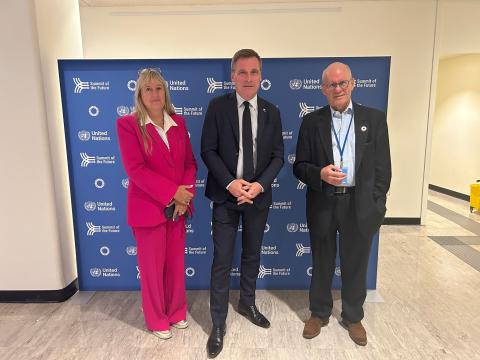
World leaders met at UN Headquarters in New York for the Summit of the Future on 22-23 September. They adopted the much awaited for Pact for the Future - a comprehensive agreement addressing peace, development, climate, technology, and human rights, with concrete commitments to guide international action in the coming decades. The Pact includes a Global Digital Compact and a Declaration for Future Generations.
Right before the Summit, an EESC delegation (comprising the EESC President, NAT President, REX Vice-President and the Chair of the EESC Youth Group) actively participated in the Summit's Action Days, convened to gather momentum and support from all actors involved in the preparation of the Pact.
Through several bilateral meetings and participation in high-level side events at the UN, the SDSN Pre-Summit at Columbia University and the Global People's Assembly, the EESC reiterated several key messages in the five major areas of the Summit of the Future, building on adopted opinions and several months of cross-cutting preparatory work:
- Sustainable Development and Financing for Development: The EESC advocated for a just and inclusive transition to climate neutrality, with a focus on job creation and skills development in green sectors. It emphasized the importance of sustainable food systems, prioritizing healthy diets, fair supply chains, and resilient agricultural practices. Additionally, the EESC called for a reformed global financial architecture, including innovative SDG financing mechanisms like debt relief to support vulnerable regions.
- International Peace and Security: The EESC highlighted the critical role of civil society in peace-building and conflict prevention, urging for their structured involvement in decision-making processes. It emphasized the need to protect vulnerable groups, such as women and children, especially in conflict zones. The EESC also called for reform of the UN Security Council to strengthen its ability to maintain international peace, while addressing the growing threats posed by climate change to global security.
- Science, Technology, and Innovation and Digital Cooperation: The EESC promoted an inclusive and sustainable digital transformation, stressing the need to bridge the digital divide, enhance digital literacy, and reduce the digital gender gap. It supported human-centred approaches to AI and advocates for policies that prioritize open science, open-source technologies, and ethical innovation, ensuring digital development benefits all sectors of society without harmful environmental impacts.
- Youth and Future Generations: The EESC is committed to empowering youth and ensuring their meaningful participation in shaping policy, particularly on sustainable development. It supports policies that tackle youth poverty and social exclusion and advocates for greater youth involvement in decision-making processes. The EESC presented its current experience with the EU "youth test" to ensure youth perspectives are mainstreamed into policy creation.
- Transforming Global Governance: The EESC called for a fundamental reform of the global governance system, advocating for more equitable representation within international institutions, particularly the UN. It emphasized the need for a more transparent and efficient UN to address current global challenges and urges the restructuring of the global financial system to align financial flows with climate and sustainability goals, moving beyond GDP as the sole measure of progress.

The EESC and African Union ECOSOCC also presented a Joint Declaration for the Summit. This declaration outlines a shared vision for a fairer, more inclusive, and equitable world. Both institutions call for a reinvigorated multilateral system where civil society is empowered to actively engage in global governance, climate action, and development financing.
As a vital pillar of Europe’s organized civil society, the EESC remains deeply committed to promoting sustainable development, social justice, and global equity. The Summit of the Future was a unique opportunity to discuss on and advance global governance reform and reaffirm the EESC commitment to accelerate implementation efforts on the 2030 Agenda for Sustainable Development.
Work organisation
Related content
Recommended for you
Toghadh Séamus Boland ina Uachtarán ar Choiste Eacnamaíoch agus Sóisialta na hEorpa, agus gheall sé go gcuirfear an tsochaí shibhialta i gcroílár na hEorpa
News
Toghadh Séamus Boland na hÉireann ar an 35ú Uachtarán ar Choiste Eacnamaíoch agus Sóisialta na hEorpa (CESE) le haghaidh an téarma oifige 2025-2028. Is urlabhra riamh anall é do phobail na tuaithe…
CESE, Uachtarántacht na hÉireann agus an fhís choiteann atá acu
News
I ndiaidh na díospóireachta a reáchtáladh le Comhaltaí CESE le linn sheisiún iomlánach mhí Iúil, níl aon dabht faoi ach go bhfuil clár Uachtaránacht reatha an Aontais ag freagairt go mór do na…
#YEYS2022: Ceist na bréagaisnéise pléite ag aos óg na hEorpa agus a dtuairimí ina leith curtha in iúl acu don Leas-Uachtarán Jourová
News
Chuir daltaí meánscoile ó gach cearn den Eoraip ocht gcinn de thograí nithiúla faoi bhráid Leas-Uachtarán an Choimisiúin Eorpaigh um Luachanna agus um Thrédhearcacht, Věra Jourová. Bhí páirt á…
#CivilsocietyforUkraine
News
Cáineann CESE ionradh Rialtas na Rúise ar an Úcráin, ionradh atá gan údar agus gan chúis Rún ó Choiste Eacnamaíoch agus Sóisialta na hEorpa (CESE) maidir leis an gcogadh san Úcráin agus an tionchar…
Eagrán speisialta de CESE info
News
Eagrán speisialta de CESE info atá dírithe ar an Úcráin. Is féidir scéal Tetyana Ogarkova a léamh, bean a chuala fuaim ionradh na Rúise ar dhúiseacht di an 24 Feabhra.